How can physics-based digital twins help heavy machinery manufacturers develop and validate increasingly complex machines and intelligent subsystems while reducing the need for physical prototypes?
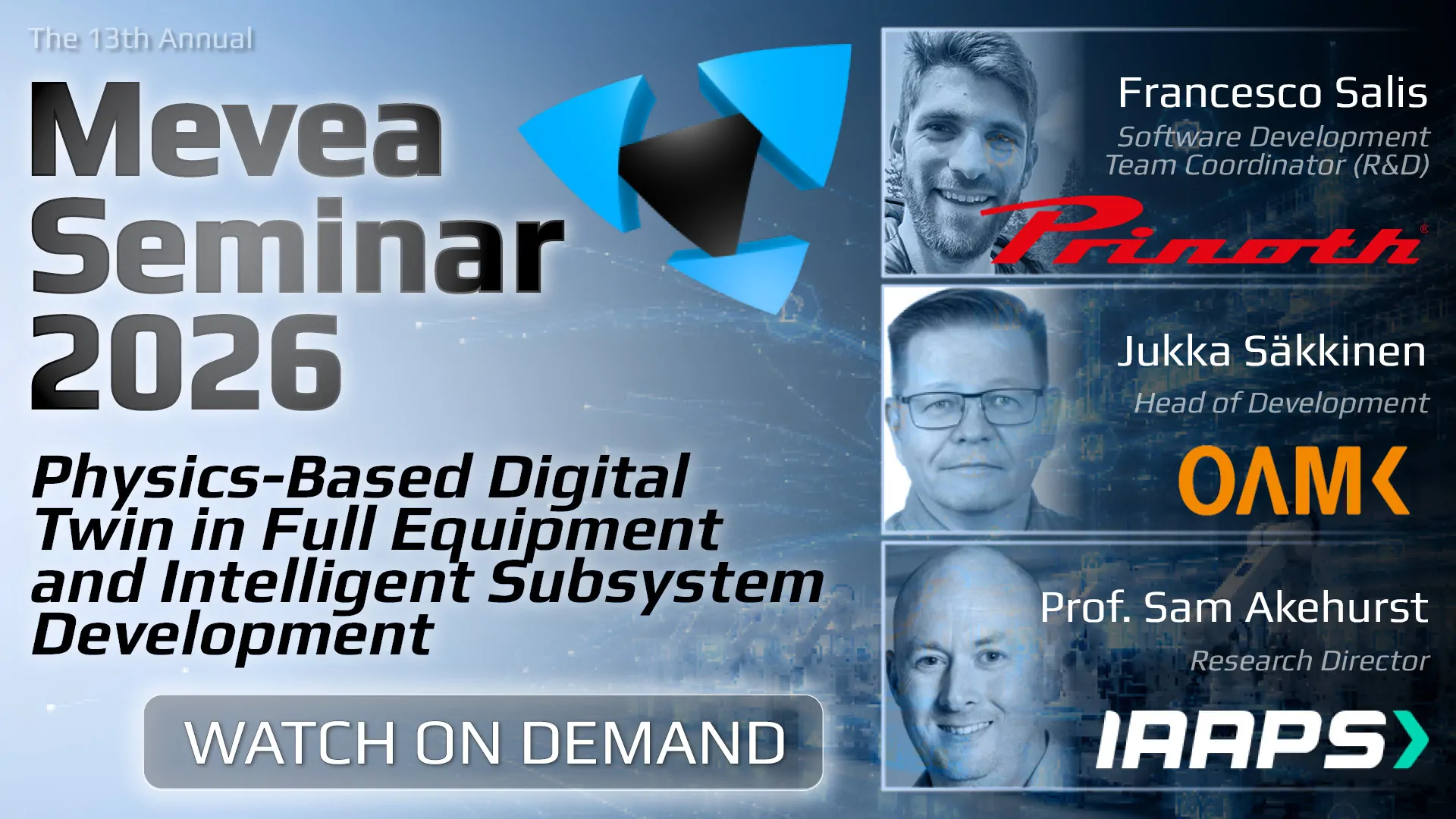
Watch the on-demand replay of Mevea Seminar 2026, held on 14 October, and explore how real-time simulation supports full equipment development, machinery electrification, and verification and validation.
The 13th annual Mevea Seminar brings together experts from Prinoth, Oulu University of Applied Sciences (Oamk), und das Institut für fortgeschrittene Fahrzeugantriebssysteme (IAAPS) to share three practical industry and research use cases.
Discover how simulation is being applied to develop a fully electric snow groomer, reproduce real-world vehicle loads in a laboratory, and evaluate hybrid powertrain strategies using physical engine testing.
From Engineering Complexity to Earlier Validation
Electrification, hybridization, and intelligent control systems are increasing the complexity of heavy machinery development. Engineering teams must evaluate interactions between mechanical systems, powertrains, hydraulics, control software, and operating environments — often before a complete physical prototype is available.
Physics-based digital twins enabled by Mevea Simulationssoftware provide a platform for studying complete machines and their intelligent subsystems in realistic operating conditions.
By combining machine dynamics, control systems, work processes, and environmental interactions, engineers can investigate design alternatives, test demanding operating scenarios, and support verification and validation earlier in development.
The seminar demonstrates these capabilities through three real-world applications.
Drei Anwendungsfälle aus Industrie und Forschung
1. Electric Snow Groomer Development: From the Concept to the Snow Through Virtual Simulation – Prinoth, Italy
Francesco Salis, Software Development Team Coordinator (R&D), Prinoth
Learn how Prinoth used digital twins, field data, and virtual simulation in the development of its fully electric LEITWOLF snow groomer.
The presentation explores energy storage and drivetrain dimensioning, power distribution and control strategies, and the simulation of demanding operating conditions. It also illustrates how virtual testing helped the development team investigate critical scenarios before the physical machine was available.
2. Vehicle-in-the-Loop Testing and Measured Results – Oamk, Finland
Jukka Säkkinen, Head of Development, Oulu University of Applied Sciences
Explore how Oamk’s Nuvelab research environment connects physical machinery and drivetrains with real-time digital twins to reproduce realistic operating loads in laboratory conditions.
The presentation compares simulated laboratory loads with measurements from actual off-road machinery operation, demonstrating the opportunities and challenges of using Vehicle-in-the-Loop testing for machinery development and validation.
3. Digital Twins for Cleaner Off-Highway Machinery – IAAPS, United Kingdom
Professor Sam Akehurst, Research Director, Institute for Advanced Automotive Propulsion Systems (IAAPS)
Discover how the Digital Twin Technologies for Cleaner Off-Highway Machinery (DITCH) project combined simulation models with a physical JCB diesel engine on a dynamometer.
The presentation examines hybrid powertrain configurations, control strategies, component sizing, and fuel consumption under representative machine operating loads. It demonstrates how integrating virtual machinery with physical testing can help engineers evaluate powertrain concepts before building a complete machine prototype.
The replay also includes a Überblick über die Mevea-Softwarelösungen von Dr. Asko Rouvinen, Senior Technical Advisor bei Mevea, introducing the simulation capabilities and integration approaches behind these applications.
Wer sollte zusehen?
This seminar is particularly relevant to engineering leaders, R&D specialists, and technical decision-makers at heavy machinery OEMs, component and technology suppliers, and research organisations working in:
- Entwicklung auf Maschinen- und Systemebene
- Physics-based simulation and digital twins
- Electrification and hybrid powertrain development
- Control systems, automation, and software development
- Virtual verification, validation, and in-the-loop testing
Watch the Mevea Seminar 2026 Replay
Access the free seminar recording on demand and discover practical approaches to reducing development uncertainty, studying complex machinery systems, and bringing realistic testing into earlier development phases.
Complete the form below to receive your replay link by email. Watch anytime, as often as you like. If you don’t receive the confirmation email, please check your spam folder.
Looking for more details? Meet the speakers below the form.
Über die Referenten
Francesco Salis – Prinoth, Italy
Software Development Team Coordinator (R&D)
Francesco Salis works in software development and R&D at Prinoth, an Italian manufacturer of snow grooming and tracked machinery. His work involves software development for advanced machinery, combining engineering expertise with the practical requirements of demanding operating environments.
Jukka Säkkinen – Oulu University of Applied Sciences (Oamk), Finland
Leiter Entwicklung
Jukka Säkkinen is a key contributor to Oamk’s Autonomous Work Machines research programme and the Nuvelab research and testing environment. His expertise spans powertrain testing, digital twins, and Vehicle-in-the-Loop (ViL) and Hardware-in-the-Loop (HiL) methodologies. He works closely with industry and research organizations to advance the development and validation of intelligent and energy-efficient mobile machinery.
Professor Sam Akehurst – IAAPS, United Kingdom
Research Director, Institute for Advanced Automotive Propulsion Systems (IAAPS), University of Bath
Professor Sam Akehurst specializes in advanced powertrain research and development at the University of Bath and IAAPS. His research focuses on improving propulsion system efficiency and reducing emissions through innovative powertrain technologies, including hybrid and electrified solutions for demanding vehicle and machinery applications.