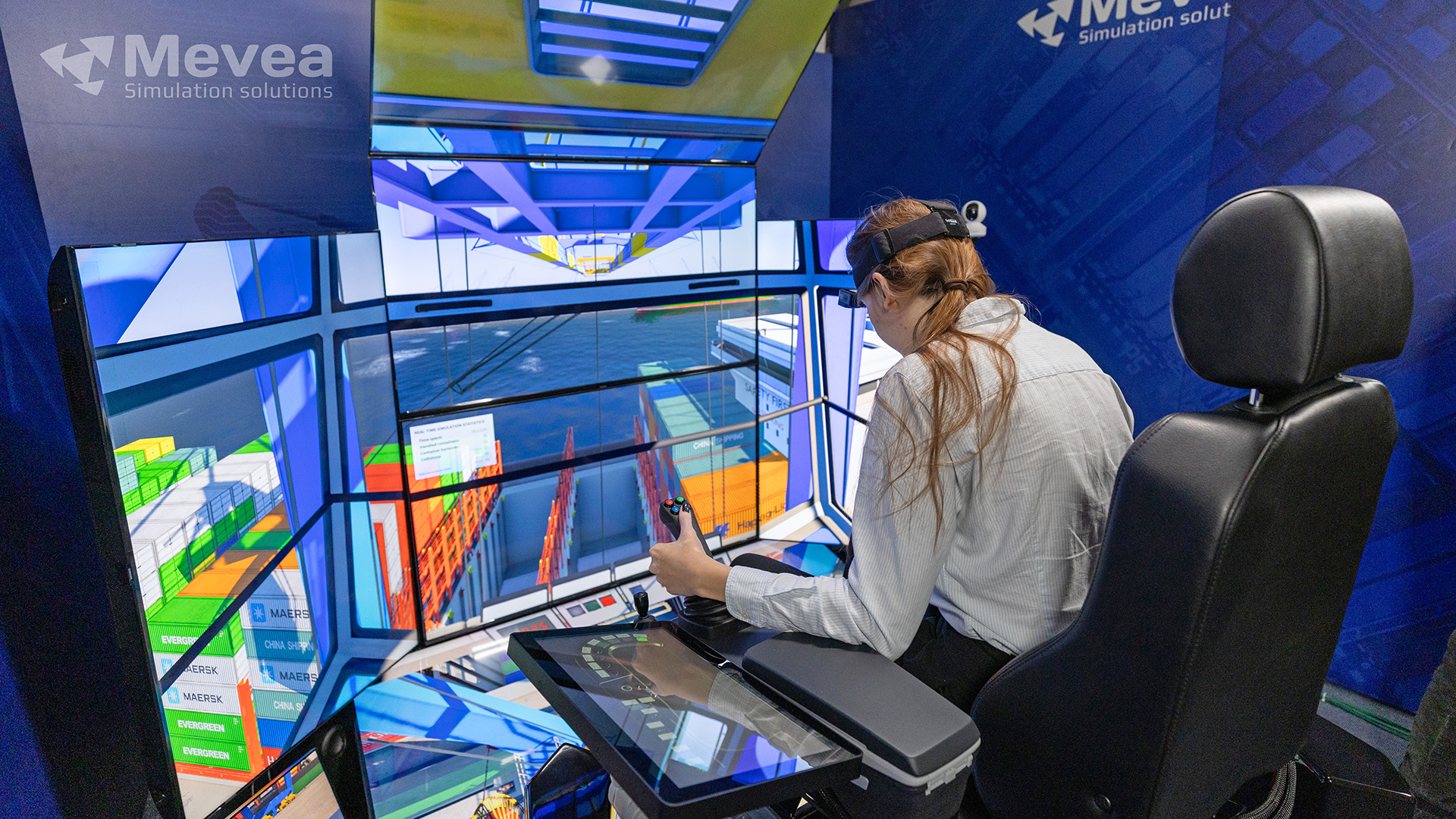
Realism in crane simulator training directly determines whether skills learned in the virtual environment transfer to real-world operations. When a simulator accurately replicates the physics, controls, and environment of actual equipment, operators build genuine muscle memory and decision-making instincts they can apply immediately on the job. The insights and information in this article are drawn from the on-demand Mevea webinar How Port Operators Are Trained with Simulators, which features a real customer case from Terminal Portuario de Guayaquil (TPG), part of Hanseatic Global Terminals (HGT). The sections below unpack the specific factors that make simulator realism matter and how to evaluate whether a training system meets professional standards.
How Does Simulator Realism Affect Crane Operator Skill Transfer?
Simulator realism is the single most important factor in skill transfer for crane operator training. When the virtual environment closely mirrors real equipment behavior, operators develop responses and reflexes that carry over directly to live operations. When it does not, operators reject the training as irrelevant, and the learning value is lost before it begins.
This is not a theoretical concern. Operators who have trained on generic or low-fidelity simulators frequently respond with immediate skepticism: “This is not my yard,” “This is not my ship-to-shore,” or “This is not the real thing.” These reactions are not complaints about aesthetics. They signal that the operator’s brain is not accepting the virtual environment as a valid proxy for real work, which means the neural pathways being trained will not activate in the actual cab.
Conversely, when a simulator is built to match a specific terminal, specific equipment, and specific operating conditions, operators recognize their environment and engage with the training fully. The skill transfer that follows is measurably stronger because the brain has been practicing the right thing, in the right context, under the right conditions.
What Makes a Crane Simulator Realistic Enough for Professional Training?
A crane simulator is realistic enough for professional training when it accurately reproduces the physical behavior of the equipment, the visual environment of the actual workplace, and the sensory feedback operators rely on during real operations. Visual fidelity alone is not sufficient. Realism must extend to how the machine moves, responds, and feels under load.
The key elements that define professional-grade realism include:
- Physics accuracy: The simulator must replicate crane mechanics, load swing dynamics, hydraulic response, and drivetrain behavior in real time.
- Control authenticity: Joysticks, pedals, and cab layouts must match the actual equipment the operator will use.
- Environmental customization: The simulated yard, vessel configuration, and container layout should reflect the operator’s real terminal.
- Variable conditions: Wind, weather, visibility changes, and equipment wear scenarios must be trainable.
- Instructor oversight tools: Trainers need the ability to monitor performance in real time, introduce faults, and deliver structured feedback.
Customization is often the deciding factor between operator acceptance and rejection. Terminals that invest in building their specific environment into the simulator find that operators are surprised and engaged rather than dismissive. As highlighted in the Mevea webinar featuring TPG and HGT, when operators stepped into a fully customized simulator, they immediately recognized they were in their own terminal, which transformed their willingness to train seriously.
How Does Physics-Based Simulation Differ from Basic Crane Simulators?
Physics-based simulation calculates the real-time mechanical behavior of a crane using mathematical models of its actual systems, including mechanics, hydraulics, power transmission, and load dynamics. Basic crane simulators use simplified or scripted animations that approximate how a crane looks without accurately modeling how it behaves. The difference is fundamental to training quality.
In a basic simulator, a load may swing in a predictable, looped pattern regardless of operator input. In a physics-based system, the load responds dynamically to every control input, wind force, and acceleration change the way it would on a real crane. This means operators must actively manage load behavior rather than learning scripted responses that will not work in real operations.
Physics-based simulation also enables accurate reproduction of edge cases and fault conditions. Hydraulic pressure drops, mechanical resistance, and load imbalances can all be modeled and trained against. This level of fidelity is what separates a training tool from a demonstration tool. Our simulation software is built on a proprietary physics engine that models crane mechanics, hydraulics, and operating environment simultaneously in real time, which is why the behavior operators experience in the simulator corresponds directly to what they encounter on the job.
What Types of Crane Operations Can Be Trained in a Simulator?
Modern crane simulators support training across the full range of port and terminal crane operations, from basic equipment familiarization to complex multi-crane coordination and emergency response. Both novice operators and experienced professionals can benefit from structured simulator training at different levels of difficulty.
Specific operations that can be trained include:
- Ship-to-Shore (STS) crane operations, including vessel approach, spreader alignment, and hatch sequencing.
- Rubber Tyred Gantry (RTG) and Rail Mounted Gantry (RMG) container stacking and retrieval.
- Mobile Harbour Crane (MHC) and offshore crane lifts.
- Reach stacker and empty container handler operations.
- Straddle carrier maneuvering and container placement.
- Terminal tractor and internal transfer vehicle operations.
- Operations under adverse weather conditions, including wind, rain, and reduced visibility.
- Emergency procedures and fault response scenarios.
The ability to practice the same operation repeatedly under controlled conditions is one of the core advantages of simulator training. Instructors can reset scenarios instantly, introduce specific challenges, and adjust difficulty without any of the operational disruption or safety risk that live equipment training would involve.
Does Simulator Training Actually Improve Real-World Crane Performance?
Yes. Crane operators trained on high-fidelity simulators consistently demonstrate stronger performance when they transition to real equipment, particularly in the early stages of their operational career. The improvement is most measurable in load control precision, operational speed, and safety-critical decision-making under pressure.
The mechanism behind this improvement is straightforward. Simulator training allows operators to accumulate hours of deliberate practice in scenarios that would be too risky, too costly, or too disruptive to replicate on live equipment. By the time an operator enters a real cab, they have already made and corrected the errors that would otherwise happen on the job, often at significant cost.
Operators who complete structured simulator training before moving to live equipment tend to reach productive performance levels faster than those who learn exclusively through on-the-job experience. They also bring better habits into the real environment because they have practiced correct technique consistently rather than learning workarounds under production pressure. The result is measurable throughput improvement alongside a reduction in equipment damage and near-miss incidents.
When Should a Port Operator Choose Simulator Training over On-the-Job Training?
Simulator training is the stronger choice whenever safety risk, equipment availability, or operational continuity makes on-the-job training impractical. This covers most professional crane training scenarios, particularly for novice operators, equipment transitions, and high-consequence procedure practice.
Specific situations where simulator training is clearly preferable include:
- New operator onboarding: Trainees can build foundational skills without occupying productive equipment or creating safety exposure.
- Equipment transitions: Experienced operators switching to a new crane model or terminal configuration can adapt in a controlled environment before going live.
- Emergency and fault training: Scenarios involving equipment failure, load incidents, or extreme weather cannot safely be practiced on real cranes.
- Night shift or off-peak skill building: Simulator access is not constrained by operational schedules.
- Performance remediation: Operators with identified skill gaps can target specific weaknesses without the scrutiny or risk of live operations.
On-the-job training remains valuable for final familiarization and supervised live practice, but it works best once a solid foundation has already been built in the simulator. Combining both approaches gives operators the depth of simulated practice and the contextual experience of real operations, which is the most effective path to competent, confident crane operation.
Our port crane simulator solutions are built specifically to support this combined approach, with customizable terminal environments and a full range of equipment types covered in a single training platform.
Watch the Webinar: How Port Operators Are Trained with Simulators
The insights throughout this article are based on the on-demand Mevea webinar How Port Operators Are Trained with Simulators. The replay is now available and features a real customer case from Terminal Portuario de Guayaquil (TPG), part of Hanseatic Global Terminals (HGT), including first-hand insights from the Technical Manager at TPG. The webinar covers how simulator-based training helps modern container terminals improve operator readiness, reduce costs, and avoid operational disruptions — all while raising safety and productivity standards.
Watch the on-demand webinar replay here and see how leading port operators are putting simulator training into practice.
This content was generated with the help of AI and it may contain mistakes