Every late-stage design failure costs your team more than time. It costs credibility, budget, and months you cannot recover before your next product launch window closes.
For OEM manufacturers developing complex heavy equipment, the gap between a promising design and a validated product is where development risk lives. Real-time simulation software closes that gap before a single physical prototype is built.
How Late-Stage Failures Drain OEM Development Budgets
Finding a hydraulic integration error or a control system conflict in the final testing phase is not just frustrating. It triggers a cascade: redesign, remanufacture, retest. Each cycle adds cost and pushes your launch date further out.
Physical prototypes for heavy equipment routinely run into hundreds of thousands of euros. When a design flaw surfaces late, you are not just paying for a new part. You are paying for lost time in a market where your competitors are moving fast.
The core problem is that traditional development processes surface errors too late. Mechanical, hydraulic, electrical, and control systems are tested in isolation and only integrated at the end, when changes are most expensive.
Physics-Based Digital Twins Built for Engineering Precision
Not all simulation is equal. Visual simulations look convincing but cannot predict real machine behavior under load, dynamic stress, or complex hydraulic interaction.
Our Mevea Simulation Software is built on a proprietary physics engine that accurately models the mechanics, hydraulics, powertrain, and operating environment of your machine in real time. This is physics-based simulation designed for engineering decisions, not just presentations.
With Mevea, you can build digital twins for heavy equipment that behave the way your actual machine will behave. The same digital twin can be utilized throughout the entire product lifecycle — from early concept validation through to operation and product upgrades. That means:
- Testing design variants under realistic load conditions without physical hardware
- Validating hydraulic and mechanical system interactions early in the product development cycle
- Running thousands of operating scenarios that would be impractical or unsafe on a physical machine
- Identifying integration failures before they become expensive late-stage surprises
- Reusing product development digital twins for sales, marketing, and operator training
The result is a virtual prototype that gives your engineering team real data to act on, not approximations.
Mevea Modeller: Building Your Digital Twin
Mevea Modeller is the software tool used to develop digital twins based on real-time multibody dynamics simulation extended with multi-physics capabilities. A digital twin built in Mevea Modeller can include the machine model, working environment, work process, virtual sensors, hydraulics, powertrain, and an I/O interface to the machine control system.
Mevea Modeller uses assemblies to simplify the management of different product variants and product families. An assembly can consist of a single component — such as a boom variant or an attachment — or a more complex system such as hydraulics, a driveline, or a working environment. The simulation environment can also include deformable soil, enabling realistic simulation of work processes such as excavation and bulk material handling.
Virtual sensors supported within the model include hydraulic pressure sensors, laser scanners, and LiDAR sensors. Existing sub-models created in other simulation environments can also be integrated using the standardized Functional Mock-up Interface (FMI) or Mevea’s synchronous interface. Weather conditions, multiple camera positions, realistic audio effects, and operator interface components such as touch screens can also be included, creating an immersive digital twin that operates in a manner comparable to the real physical machine.
From Virtual Prototypes to Hardware-in-the-Loop Testing
Simulation should not stop at the digital model. As your design matures, you need to validate real control hardware against simulated machine behavior.
Mevea supports Hardware-in-the-Loop (HIL) testing, connecting physical control units directly to our real-time simulation environment. Your actual ECU or PLC interacts with a simulated machine that responds with physics-accurate behavior. The Mevea I/O Toolbox enables this connection, supporting physical CAN and CANOpen buses, socket connections to PLCs, and large numbers of inputs and outputs. PLCs can also act as a bridge between socket connections and different bus approaches, and the solution handles physical control signals including voltage, current, and PWM.
This means you can stress-test your control logic, detect edge-case failures, and validate autonomous system development in conditions that are impossible to recreate safely in the field. The Mevea Solver runs models in real time, combining computational efficiency with numerical stability, and allows your team to inspect hydraulic schematics, visualize internal valve spool movements, generate hydraulic and I/O signal faults, and study control system behavior in situations that may be difficult or impossible to reproduce with a real machine. All of this happens before you commit to a physical build.
Integration with CAD, PLM, and Control System Environments
A simulation tool that sits outside your existing workflow creates friction, not value. Mevea is built to integrate with the engineering environments your team already uses.
Our software connects with CAD and PLM systems, allowing you to import geometry and design data directly into the simulation environment. Numerical information and visualization graphics can be generated directly from CAD software such as PTC Creo. Mevea physics simulations can also be visualized using graphics engines such as Unity, making it possible to create high-level visualizations and use the digital twin for purposes such as training and marketing.
For autonomous system development, Mevea interfaces support integration with ROS and ROS2 development platforms, with predefined sensor assemblies including IMU, odometer, GPS, camera, and LiDAR. Co-simulation can be implemented using the FMI standard or Mevea’s direct interfaces, for example with MATLAB/Simulink. Mevea also provides C++, C#, and Python interfaces for direct access to the Mevea I/O interface and communication with external sensors and systems.
This connected approach means:
- Design changes propagate into simulation without manual rework
- Cross-disciplinary teams test integrated system behavior from a single source
- Validation data feeds back into your existing product lifecycle processes
- You reduce prototype costs by catching integration issues in the digital environment first
Digital Twins Across the Full Product Lifecycle
One of the most significant advantages of Mevea’s approach is that a digital twin does not become redundant once a product enters production. The same model that supported concept validation and virtual prototyping can continue to deliver value at every subsequent stage.
In manufacturing, digital twins can be used for virtual preparation for Factory Acceptance Tests. In sales and marketing, they enable experience-based demonstrations, allowing a potential customer to interact with a machine virtually even before the physical machine is available. In training, digital twins can be used to train machine operators, supervisors, service personnel, users of remotely operated systems, and personnel working with autonomous systems.
Once the physical machine is in operation, the digital twin supports operation optimization, performance analysis, problem detection and solving, and product upgrade and modernization planning. This lifecycle approach means your investment in simulation compounds in value rather than being confined to a single development phase.
Proven in Partnership with Siemens and Leading OEM Manufacturers
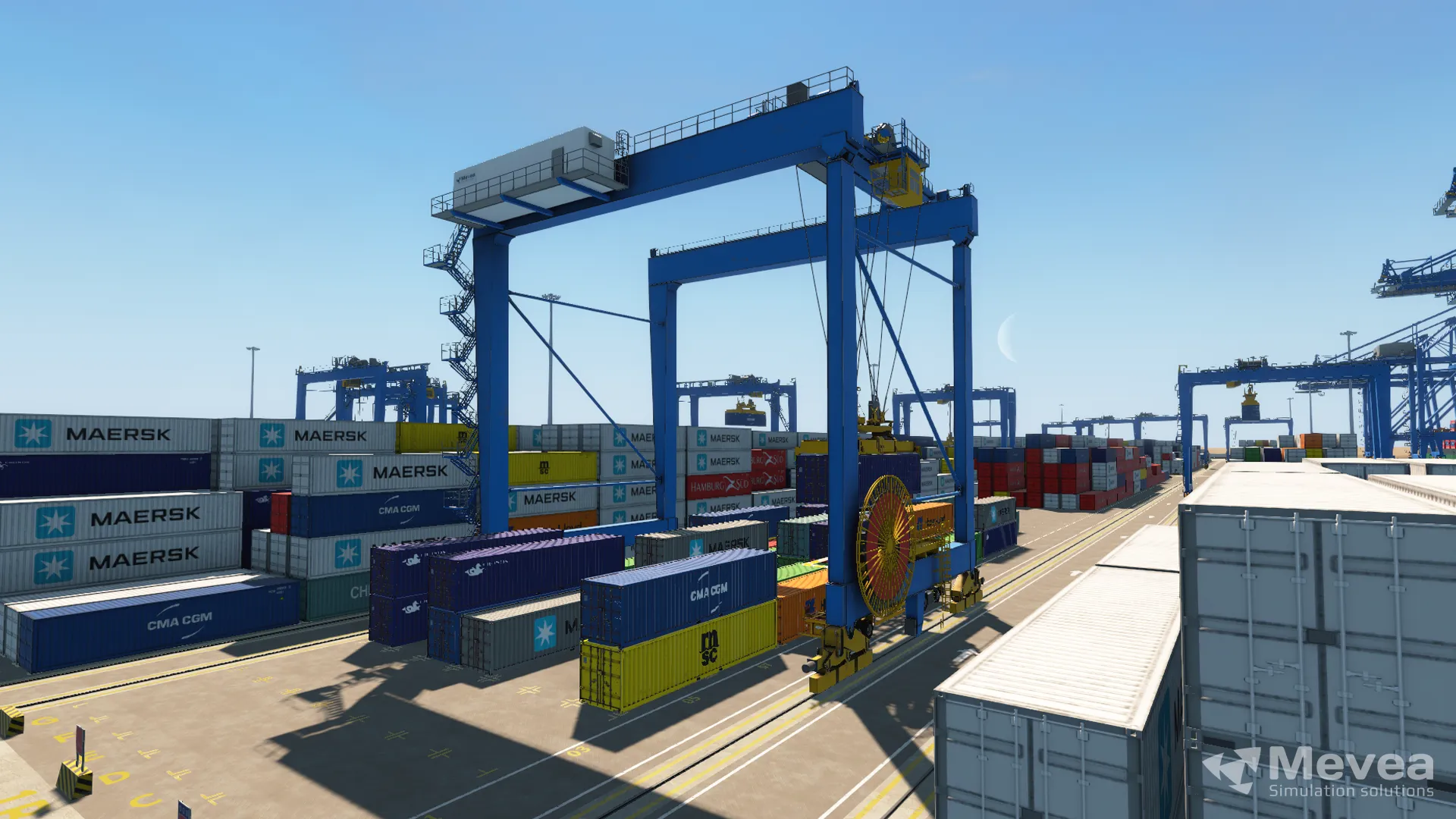
We were selected as Siemens’ simulation partner for their SIMOCRANE technology platform. That partnership was built on one thing: the accuracy of our physics engine in modeling real crane behavior and operation.
Mevea has delivered simulation solutions to leading OEM manufacturers across port equipment, construction machinery, mining, and forestry. Our customers include companies where engineering precision is non-negotiable and where development timelines directly affect competitive position.
When your engineering team evaluates a simulation platform, accuracy and long-term partnership matter more than any single feature. We are built for the full product lifecycle, not just one development phase.
Talk to Mevea’s Engineering Team About Your Development Challenge
You do not need a generic demo. You need to understand whether our simulation environment fits your specific machine architecture, development process, and integration requirements.
Our engineering team works directly with OEM development leads to map your current process, identify where simulation can reduce risk, and show you what a physics-accurate digital twin of your equipment looks like in practice.
There is no obligation and no sales pressure. Just a technical conversation with engineers who understand heavy equipment development.
- Discuss your specific machine type and development challenge
- See how HIL testing and virtual prototyping fit your workflow
- Understand integration options with your existing CAD and control systems
Reach out to Mevea’s engineering team today and start reducing development risk before your next prototype cycle begins.
This content was generated with the help of AI and it may contain mistakes