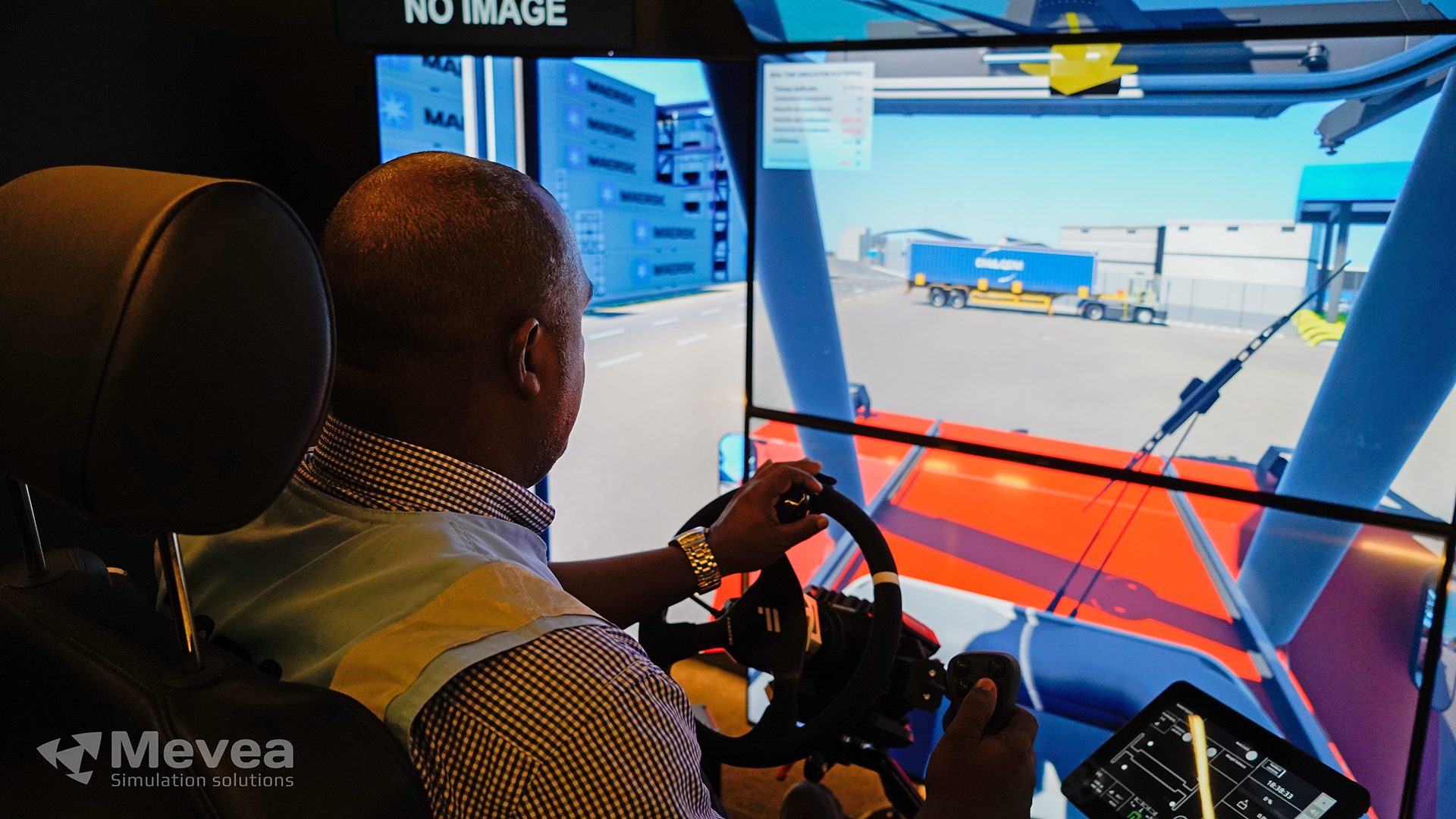
Every physical prototype you build costs hundreds of thousands of euros and weeks of engineering time. And when the design needs to change, the cycle starts over.
For OEM product development teams under pressure to move faster, that pace is no longer sustainable. There is a better way to develop, test, and validate heavy equipment.
Why Traditional Prototyping Slows OEM Development Cycles
Physical prototypes are expensive by nature. A single unit can run into the millions, and integrating hydraulics, mechanics, electrical systems, and control logic only multiplies the risk of catching errors late.
When a flaw surfaces at the prototype stage, the cost is not just financial. It is measured in months lost, delayed launches, and competitors who get to market first.
- Design changes require new physical builds, compressing your innovation cycle
- Autonomous and assistive systems need thousands of test runs across varied conditions, which is impractical and unsafe with real machines
- Integration errors between subsystems often appear only in late-stage testing, when fixes are most expensive
- Demonstrating new features to customers before production begins is nearly impossible
The bottleneck is not your team. It is the tool.
What Mevea’s Physics Engine Delivers That Visual Simulators Cannot
Most simulation tools offer visual representations. Mevea’s real-time simulation software goes far deeper.
Our proprietary physics engine accurately models machine mechanics, hydraulics, powertrain behavior, and the operating environment simultaneously, in real time. This is not a visual approximation. It is a physics-based digital twin that behaves the way your machine actually behaves.
That distinction matters enormously for product development. When your virtual prototype reacts to load, terrain, and control inputs with physical accuracy, the insights you gain are engineering-grade, not illustrative.
- Simulate real mechanical, hydraulic, and drivetrain interactions, not just motion paths
- Test control algorithms and autonomous systems against realistic physics before a single physical part is manufactured
- Validate designs under a wide range of operating conditions, including edge cases that would be dangerous to test in the field
- Support hardware-in-the-loop simulation, connecting real control hardware to a virtual machine environment
Key Capabilities for OEM Product Development Teams
Mevea Simulation Software is built for the technical demands of heavy equipment development. It gives your engineers a working virtual machine they can test, break, and iterate on without the cost or risk of physical builds.
- Physics-based virtual prototypes that accurately replicate machine behavior across mechanics, hydraulics, and powertrain systems
- Real-time digital twin construction that supports continuous testing throughout the development lifecycle
- Hardware-in-the-loop (HIL) support for validating real control units against a simulated machine
- Scenario customization to test designs under specific load conditions, environments, and failure modes
- Autonomous and assistive system development with a safe, repeatable virtual environment for algorithm testing and AI training data generation
- Customer demonstration capability so you can show new features to clients before production begins
Every capability is designed to compress the gap between concept and validated design.
Inside Mevea’s Software: Modeller, Solver, and I/O Toolbox
Mevea’s simulation environment is built around three tightly integrated components, each addressing a distinct part of the digital twin workflow.
Mevea Modeller is the tool your engineers use to build the digital twin itself. Based on real-time multibody dynamics simulation extended with multi-physics capabilities, a model can include the machine structure, working environment, work process, virtual sensors, hydraulics, powertrain, and an I/O interface to the machine control system. Modeller uses assemblies to manage product variants and families efficiently, so a boom variant, an attachment, or an entire hydraulic system can be handled as a reusable component. The simulation environment can also include deformable soil, enabling realistic simulation of work processes such as excavation and bulk material handling. Virtual sensors — including hydraulic pressure sensors, laser scanners, and LiDAR — can be embedded directly in the model.
Mevea Solver runs those models in real time, combining computational efficiency with numerical stability. Engineers can use it to view simulation results live, inspect hydraulic schematics, visualize internal valve spool movements, generate hydraulic and I/O signal faults, and study control system behavior in situations that would be difficult or impossible to reproduce with a real machine. This makes it possible to virtually verify both equipment performance and safety before any physical build takes place.
Mevea I/O Toolbox connects the digital twin to actual machine control systems. It supports physical CAN and CANOpen buses, socket connections to PLCs, and data transfer between Mevea Solver and external software or hardware. Real controllers can be integrated in hardware-in-the-loop environments, and the toolbox can handle physical control signals including voltage, current, and PWM. PLCs can also serve as a bridge between socket connections and different bus architectures, for example when connecting Profibus-based control systems.
Integrations and Interfaces
Mevea is designed to fit into your existing development environment rather than replace it. The Mevea Software API and a range of standard interfaces allow the simulation environment to connect with the tools your team already uses.
- CAD integration: Numerical dynamics data and visualization graphics can be generated directly from CAD tools such as PTC Creo
- Unity: Mevea physics simulations can be visualized using Unity, enabling high-fidelity visualizations for training and marketing applications
- ROS and ROS2: Predefined sensor assemblies — including IMU, odometer, GPS, camera, and LiDAR — support integration with ROS and ROS2 development platforms
- FMI and MATLAB/Simulink: Co-simulation can be implemented using the Functional Mock-up Interface (FMI) standard or Mevea’s direct interfaces, including MATLAB/Simulink
- C++, C#, and Python interfaces: These allow direct access to the Mevea I/O interface for communication with external sensors and systems
Digital Twins Across the Entire Product Lifecycle
One of the most significant advantages of Mevea’s approach is that the same digital twin built during product development does not have to be retired once the machine goes into production. It can continue to deliver value at every subsequent stage.
- Manufacturing: Digital twins can be used for virtual preparation for Factory Acceptance Tests
- Sales and marketing: Potential customers can experience or interact with a machine virtually before the physical product is available, enabling experience-based marketing and co-development with customers
- Training: The same model can train machine operators, supervisors, service personnel, and personnel working with autonomous or remotely operated systems
- Product in operation: Once the physical machine is in use, the digital twin supports operation optimization, performance analysis, problem detection, and product upgrade planning
This lifecycle reuse means the investment made in building a high-fidelity digital twin during development continues to generate returns long after the product has launched.
From Faster Iteration to Lower Development Costs
When your team can test a design change in a virtual prototype rather than a physical one, the development rhythm changes fundamentally. Iterations that once took weeks take days. Subsystem integration issues surface early, when they are cheap to fix.
The impact compounds across the project lifecycle.
- Fewer physical prototypes means significantly lower material and manufacturing costs
- Earlier error detection reduces the cost and disruption of late-stage design changes
- Parallel virtual testing accelerates time-to-market without increasing engineering headcount
- Reduced reliance on real machines for testing also means lower fuel consumption and CO2 emissions during development
The goal is not to eliminate physical testing entirely. It is to arrive at physical testing with a design that is already well validated, so your physical builds confirm rather than discover.
Trusted by Leading OEM Developers and Research Institutions
We work with leading OEM manufacturers across port equipment, construction machinery, mining, and forestry. Our technology has been chosen by Siemens as the real-time simulation partner for the SIMOCRANE technology platform, producing digital twins capable of simulating the behavior and operation of real cranes with high fidelity.
Since 2005, we have delivered over 100 simulator models to more than 50 customers worldwide. Our roots as a spin-off from Lappeenranta University of Technology mean our physics engine is grounded in rigorous academic and engineering science, not marketing claims.
We also collaborate actively with universities and research institutions, which keeps our technology at the frontier of real-time physics engine development and ensures our customers benefit from the latest advances in simulation science.
See Mevea’s Simulation Software in Action
If your team is evaluating physics-based simulation software for OEM product development, the most direct next step is to see what the technology can do for your specific use case.
We offer direct conversations with our engineering team, where you can explore how Mevea’s digital twin capabilities map to your development challenges, whether that is autonomous system validation, hydraulic system simulation, or reducing your prototype build cycle.
- No generic demo, but a focused discussion around your development context
- Technical depth from engineers who understand heavy equipment development
- A clear picture of integration options and what getting started looks like
Reach out to us to schedule a conversation with our team. The sooner your virtual prototype is running, the sooner your next product development cycle gets faster.
This content was generated with the help of AI and it may contain mistakes