This article is based on insights shared in the on-demand Mevea webinar How Port Operators Are Trained with Simulators, featuring a real customer case from Hanseatic Global Terminals (HGT). The webinar covers how simulator-based training improves operator performance, reduces costs, and avoids operational disruptions in demanding port environments. Watch the on-demand webinar replay here.
TPG, a high-volume container terminal operator in Ecuador and part of Hanseatic Global Terminals, successfully implemented a simulator-based operator training programme that delivered more than 2,000 accumulated training hours and reached approximately 82 to 85 operators within just eight months. The key to that success was a highly customised simulation environment that replicated TPG’s actual yard and equipment so precisely that operators felt they were working in their real terminal from day one. Below, we unpack exactly how they did it and what other terminals can learn from the approach.
What Challenges Does Operator Training Face in High-Volume Container Terminals?
In high-volume container terminals, the core training challenge is that production equipment almost never stops. When an STS crane or RTG is taken offline for a training session, it creates an immediate operational impact, disrupting cargo flow, delaying vessel turnaround, and putting pressure on already tight schedules. Organising meaningful, structured training around that constraint is extremely difficult.
TPG experienced this directly. With a high utilisation rate across its production fleet, removing a crane for training was not simply inconvenient, it was a genuine operational cost. This reality pushed training to the margins, making it reactive rather than structured, and limiting how consistently new or developing operators could build their skills.
Beyond equipment availability, terminals also face challenges around safety. Training on live equipment exposes both the trainee and the surrounding operation to risk. Mistakes that would be learning moments in a controlled setting become incidents on an active quay. The combination of equipment scarcity and safety pressure means that traditional on-equipment training in busy terminals is inherently limited in both frequency and depth.
How Does Simulator-Based Training Work for Container Terminal Operators?
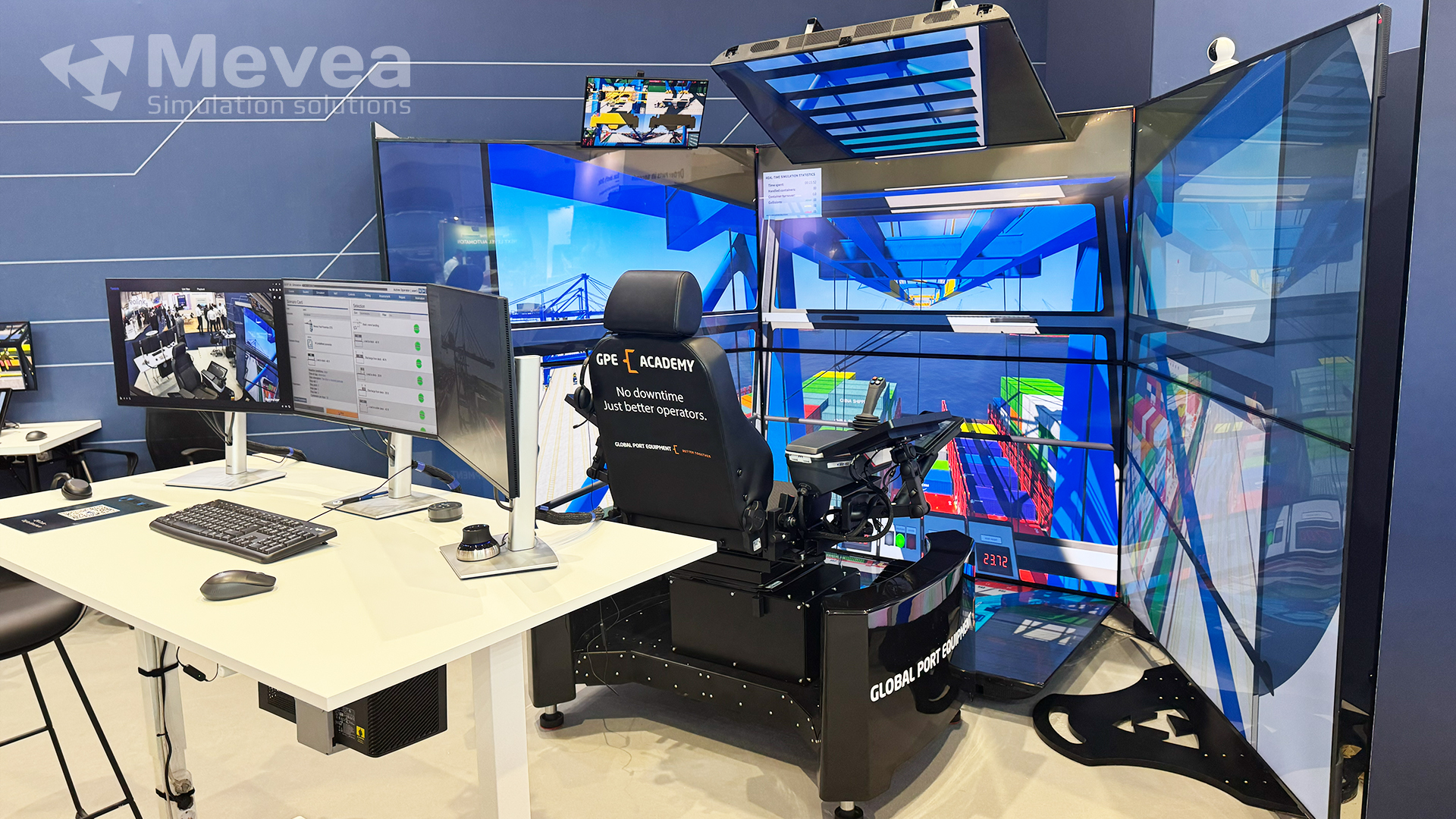
Simulator-based training for container terminal operators places trainees inside a physics-accurate virtual replica of their actual equipment and working environment. The operator uses controls that mirror the real machine, responds to realistic load behaviour, weather conditions, and yard scenarios, and receives structured feedback, all without touching live production equipment.
The quality of that simulation depends heavily on the physics engine underneath it. Our simulation software replicates crane mechanics, hydraulics, and load dynamics in real time, which means the machine responds the way a real crane would, not the way a simplified model approximates it. That physical accuracy is what builds genuine muscle memory and operational judgement rather than just screen familiarity.
An instructor station runs alongside the trainee session, giving the trainer live oversight of performance, the ability to introduce variables like wind or restricted visibility, and the tools to generate detailed feedback reports. This structure turns simulator time into a managed learning programme rather than unguided practice.
What Equipment Did TPG Train Operators on Using Simulators?
TPG configured its simulator programme to cover the full range of equipment its operators use in daily terminal operations. The training setup included three different ship-to-shore crane models, two different RTG configurations, and additional mobile terminal equipment, all running across two simulator platforms.
This breadth matters. Operators in a busy container terminal rarely work on just one machine type, and cross-training across STS cranes, RTGs, and mobile equipment builds the kind of versatility that improves overall terminal throughput. By modelling each crane variant accurately rather than using a generic approximation, TPG ensured that time spent in the simulator translated directly to competence on the actual machines in the yard.
The customisation extended to the environment itself. TPG’s virtual terminal was built to match its actual yard layout, which is a detail that proved critical for operator acceptance, as we cover in the next section.
What Results Did TPG Achieve After Adopting Simulator Training?
Within eight months of launching its simulator programme, TPG logged more than 2,000 accumulated training hours and trained approximately 82 to 85 operators. Beyond the headline numbers, Christian Etcheverry, TPG’s Technical Manager, reported concrete improvements in how operators handle equipment, in overall productivity, and in the organisation of the training programme itself. These insights were shared directly in the How Port Operators Are Trained with Simulators webinar replay, where Christian spoke as a featured customer case representative for Hanseatic Global Terminals.
Operators developed a clearer understanding of careful equipment handling. As Christian put it: “They understand the importance of handling our equipment with care.” That shift in operator mindset has implications for equipment health and longevity, even if precise maintenance savings figures were not measured at the time of reporting.
On the productivity side, Christian noted: “We are seeing an improvement in our productivity.” The structured nature of the training programme also made it easier to plan and sequence operator development without disrupting crane availability for cargo operations. The combination of better-trained operators and production equipment that stays in service is exactly the outcome high-utilisation terminals need.
How Does Simulator Training Compare to Traditional On-Equipment Training for Port Operators?
Simulator training and traditional on-equipment training differ most significantly in availability, safety, and consistency. On-equipment training requires pulling a crane out of production, creates real safety exposure, and depends on conditions that cannot be controlled. Simulator training runs independently of production schedules, eliminates injury risk during skill development, and allows instructors to set repeatable, progressively challenging scenarios.
For TPG, the practical difference was stark. Traditional training meant competing with operational demands for crane time. Simulator training meant operators could accumulate structured hours without that conflict, and instructors could run scenarios, such as adverse weather or unusual load conditions, that would be impractical or unsafe to replicate on live equipment.
The other important difference is feedback quality. On-equipment training relies heavily on an experienced operator observing and commenting in real time. The instructor station in a simulator programme captures performance data throughout every session, giving trainers objective information to work with rather than impressions. That data-driven feedback loop accelerates skill development and makes it easier to identify gaps before an operator moves to live equipment.
When Should a Container Terminal Invest in a Full Simulator Programme?
A container terminal should invest in a full simulator programme when the cost of taking production equipment offline for training consistently outweighs the cost of the programme itself, or when safety incidents and near-misses during operator development signal that on-equipment training is not adequately controlled. High utilisation rates, fleet expansion, and rapid operator onboarding needs are the clearest triggers.
TPG’s situation illustrates the case well. A terminal running cranes at high utilisation cannot afford frequent training interruptions, and the scale of its operation meant that onboarding and developing dozens of operators was an ongoing, not occasional, requirement. A simulator programme turned that continuous need into a structured, manageable process.
Terminals considering the investment should also weigh the selection criteria that TPG prioritised: realistic crane behaviour, physical accuracy, component quality, reporting capability, and above all, flexibility to customise the environment to match the actual yard and equipment. Christian’s experience showed that operators who had previously rejected simulators on other sites accepted TPG’s setup immediately because, in his words, “If you are using our simulator, you are in TPG 100%.” That level of fidelity is what converts simulator hours into real-world competence, and it is the standard any serious port equipment simulator programme should be measured against.
Our container terminal training simulators are built around exactly these principles, with physics-based accuracy across STS cranes, RTGs, reach stackers, and mobile equipment, and the flexibility to replicate any terminal’s specific environment and fleet configurations.
To see these principles in action through a real customer case from Terminal Portuario de Guayaquil and Hanseatic Global Terminals, watch the on-demand replay of the How Port Operators Are Trained with Simulators webinar and hear directly from TPG’s Technical Manager about the results their team achieved.
This content was generated with the help of AI and it may contain mistakes