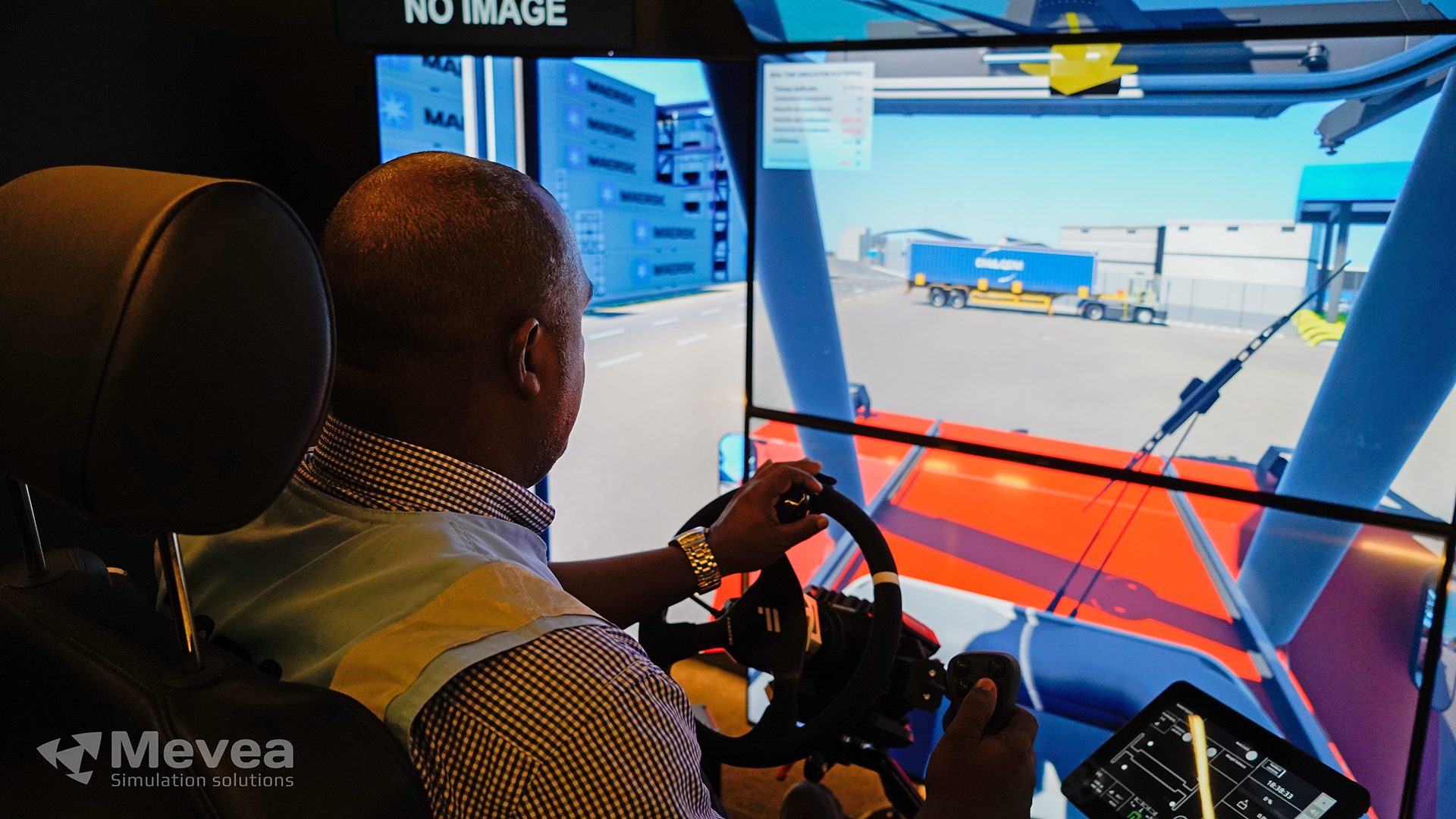
The most effective way to combine simulator training with real equipment training is to treat them as complementary stages in a single, structured pathway rather than alternatives to each other. Operators build foundational skills and confidence in the simulator first, then transfer to real machinery once they have reached a defined level of competence. This blended approach reduces risk, shortens the total time needed on live equipment, and produces better-trained operators from day one on the job. The questions below break down exactly how to design and manage that combined program — drawing on insights from the Mevea webinar How Port Operators Are Trained with Simulators, which features a real customer case from Terminal Portuario de Guayaquil (TPG), part of Hanseatic Global Terminals (HGT).
About the Mevea Webinar This Article Is Based On
The insights and examples throughout this article are drawn from the on-demand replay of the Mevea webinar How Port Operators Are Trained with Simulators. The replay features a real customer case from Terminal Portuario de Guayaquil (TPG), part of Hanseatic Global Terminals (HGT), including direct insights from the Technical Manager at TPG. The webinar covers how improving operator training while reducing costs and avoiding operational disruptions is one of the key challenges facing modern container terminals — and how simulator-based training provides a scalable, cost-efficient solution that improves safety, productivity, and workforce readiness in demanding port operations.
Watch the on-demand Mevea webinar replay here.
What Skills Are Best Learned in a Simulator Before Touching Real Equipment?
The skills best learned in a simulator before real equipment training are those that carry the highest risk or cost when practiced on live machinery. These include basic machine controls, load handling fundamentals, emergency procedures, situational awareness, and operating in adverse weather or high-traffic conditions. A simulator lets operators repeat these scenarios as many times as needed without any consequences for errors.
For port equipment operators in particular, the gap between a novice and a safe, productive operator is significant. Handling a ship-to-shore crane or an RTG requires precise coordination that takes time to develop. In a simulator, trainees can practice spreader alignment, load swing control, and stack positioning hundreds of times before they ever approach a live terminal. This repetition builds the muscle memory and judgment that would otherwise take months to develop on real equipment.
Simulator training is also the right environment for learning procedures that are rare but critical on the job, such as emergency stops, fault responses, and operations in reduced visibility. Because these events happen infrequently in real terminal operations, operators may go years without encountering them on live equipment. A simulator makes it possible to rehearse these scenarios deliberately and safely.
How Do You Structure a Blended Training Program for Equipment Operators?
A blended operator training program follows a clear progression: simulator-based instruction and practice, followed by controlled assessment, followed by supervised operation on real equipment, with the simulator continuing to support ongoing development. The exact structure depends on the equipment type, the operator’s prior experience, and the terminal’s operational environment.
A practical framework for heavy equipment training looks like this:
- Orientation and theory: Introduce the machine, its controls, and operating procedures in a classroom or desktop simulator setting.
- Guided simulator practice: Instructors lead trainees through core tasks in the simulator, correcting technique and building confidence progressively.
- Independent simulator sessions: Trainees practice scenarios independently, with the instructor monitoring performance data and providing structured feedback.
- Simulator assessment: Trainees complete a defined set of tasks to a measurable standard before progressing to real equipment.
- Supervised real equipment operation: Trainees move to live machinery under close instructor supervision, focusing on skills that require real-world conditions to fully develop.
- Continued simulator development: After initial certification, operators return to the simulator for advanced scenarios, refresher training, and new equipment familiarization.
The key principle is that each stage has clear entry and exit criteria. Trainees do not move to real equipment until they have demonstrated readiness in the simulator, and the simulator remains a development tool throughout the operator’s career, not just during initial training.
What Are the Main Differences Between Simulator and Real Equipment Performance?
The main differences between simulator and real equipment performance are physical feedback, environmental unpredictability, and psychological pressure. Even the most advanced physics-based simulator cannot fully replicate the vibration, noise, and sensory load of operating live machinery in a busy terminal. Real equipment also introduces variables, such as wind gusts, uneven loads, and bystander activity, that are harder to replicate on demand.
That said, modern simulation training has closed this gap significantly. Physics-based simulators accurately model machine dynamics, hydraulic response, and load behavior, meaning that the core operating skills transfer directly. The differences that remain are mostly about environmental immersion rather than fundamental competence.
Operators trained in a simulator may also initially underestimate the cognitive load of real terminal operations, where communication, time pressure, and the consequences of errors are all present simultaneously. This is why supervised real equipment time remains an essential part of the training program even after strong simulator performance. The blended approach ensures operators encounter that real-world complexity with a solid skill foundation already in place.
When Should Trainees Move from Simulator Training to Real Equipment?
Trainees should move from simulator training to real equipment when they can consistently complete core tasks to a defined performance standard, not after a fixed number of hours. Readiness is measured by task accuracy, response to simulated faults, and the ability to operate smoothly under time pressure, rather than simply by time spent in the simulator.
Using performance data from the simulator’s instructor station makes this decision objective rather than subjective. Instructors can review metrics such as load swing frequency, positioning accuracy, and response time to determine whether a trainee is genuinely ready or whether additional simulator practice would be more beneficial than early exposure to live equipment.
Some trainees will reach readiness faster than others, and a well-structured program accommodates that variation. Rushing trainees to real equipment before they are ready increases the risk of incidents and often results in slower overall progress, because bad habits formed under pressure on live machinery are harder to correct than errors caught in the simulator.
How Can Simulator Training Reduce the Total Time Needed on Real Equipment?
Simulator training reduces the total time needed on real equipment by ensuring that operators arrive at the machine already competent in the fundamentals. Instead of using expensive live equipment time to teach basic controls and procedures, instructors can focus real equipment sessions on the specific skills and environmental conditions that only live operation can provide.
This efficiency compounds across the entire training program. Operators who have practiced load handling hundreds of times in a simulator require far fewer supervised hours on a real crane to reach certification standard. Real equipment time becomes targeted and purposeful rather than exploratory, which also reduces wear on machinery and lowers fuel and maintenance costs associated with training.
This benefit is demonstrated clearly in the HGT and TPG customer case featured in the Mevea webinar. Operators who complete structured simulator preparation before moving to real equipment not only reach competency faster but also demonstrate higher productivity from their first weeks on the job, because their foundational technique is already solid when they encounter live conditions. Watch the webinar replay to hear directly from the Technical Manager at TPG about how this played out in practice.
What Role Does the Instructor Play in a Combined Training Approach?
In a combined training approach, the instructor’s role shifts from direct demonstrator to structured facilitator and performance analyst. Rather than spending most of their time operating alongside trainees on live equipment, instructors design training scenarios, monitor simulator performance data, provide targeted feedback, and make informed decisions about when each trainee is ready to progress.
The instructor station built into simulator platforms is central to this role. It gives instructors real-time visibility into trainee performance, the ability to introduce faults or change conditions mid-exercise, and access to session recordings and performance metrics for post-exercise debriefs. This data-driven feedback loop is one of the most valuable aspects of simulator-based operator training, because it makes coaching specific and evidence-based rather than impressionistic.
On real equipment, the instructor’s role becomes more observational and contextual. Because trainees already have the foundational skills, the instructor can focus on refining judgment, building confidence under real operational pressure, and introducing the nuances of the specific terminal environment. The result is a training relationship that is more efficient and more effective than one built entirely around live equipment supervision.
To see how this approach works in a real port environment, watch the on-demand replay of the Mevea webinar How Port Operators Are Trained with Simulators, featuring the customer case from Terminal Portuario de Guayaquil (TPG), part of Hanseatic Global Terminals (HGT).
This content was generated with the help of AI and it may contain mistakes