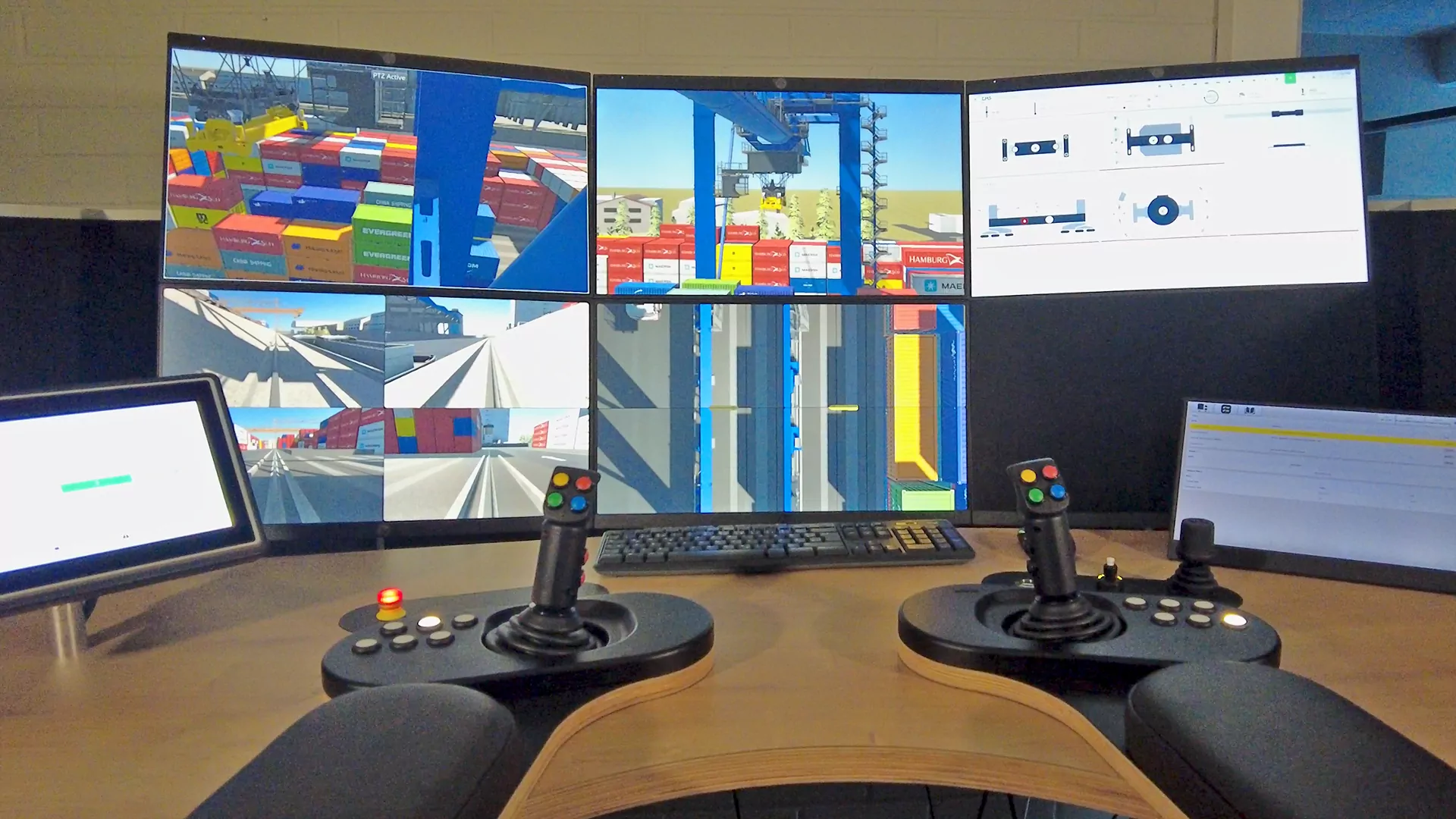
An effective port operator training program combines structured classroom instruction, hands-on equipment familiarization, and simulator-based practice into a progressive curriculum that builds competence safely before operators work with live equipment. The program needs dedicated training personnel, clear milestones, and active support from both operations and human resources to deliver lasting results. The insights in this article are drawn from the Mevea webinar How Port Operators Are Trained with Simulators, which features a real customer case from Terminal Portuario de Guayaquil (TPG), part of Hanseatic Global Terminals (HGT), including perspectives from TPG’s Technical Manager. Below, we answer the most common questions about building and running a training program that actually works.
What Skills Does a Port Operator Need Before Starting Work?
Before operating port equipment independently, a new operator needs a foundation of spatial awareness, load handling principles, equipment-specific controls knowledge, and a thorough understanding of terminal safety procedures. These skills form the baseline that all further training builds on, and gaps at this stage create safety risks that are difficult to correct later.
Spatial awareness is particularly critical in container terminal environments, where operators must judge distances, heights, and load swing in three dimensions, often from elevated positions or through camera feeds. Alongside this, operators need to understand load dynamics, including how weight distribution, wind, and acceleration affect a suspended container or piece of cargo.
On the procedural side, new operators must be familiar with:
- Terminal safety rules and emergency stop procedures
- Communication protocols with ground crews and traffic control
- Pre-operational equipment checks and fault reporting
- Basic understanding of terminal operating system (TOS) interfaces
Harbor equipment operator training programs that assess these baseline competencies before progressing to equipment-specific instruction tend to produce faster, more consistent results.
What Are the Key Stages of an Effective Port Operator Training Program?
An effective port operator training program typically moves through four stages: orientation and safety induction, simulator-based skills development, supervised live equipment practice, and independent operation with ongoing assessment. Each stage has clear entry and exit criteria, and progression depends on demonstrated competence rather than time spent.
The first stage covers the terminal environment, safety regulations, equipment overview, and communication standards. This gives operators the context they need before they touch any controls.
The second stage is where simulator training does its most important work. Trainees build muscle memory, learn to read equipment behavior, and practice high-risk scenarios, such as equipment malfunctions or adverse weather, without any operational consequence. This is also where instructors can identify individual weaknesses and tailor exercises accordingly.
The third stage moves trainees to live equipment under direct supervision. By this point, operators already have the foundational skills, so supervisors can focus on refining technique and building confidence in real conditions rather than teaching from scratch.
The fourth stage transitions operators to independent work, supported by periodic performance reviews and refresher training. A well-designed container terminal operator training program does not end at certification; it includes a structured pathway for ongoing development.
Critically, purchasing simulator technology alone is not enough. As industry experience consistently shows — and as the HGT and TPG case discussed in the Mevea webinar demonstrates — successful training requires a structured program, people dedicated to running it, and genuine organizational support. The cooperation between the training function, operations, and human resources is what holds the whole system together.
How Does Simulator Training Fit into a Port Operator Program?
Simulator training fits into a port operator program as the bridge between classroom knowledge and live equipment practice. It gives trainees a realistic, repeatable environment to develop core operating skills, handle emergency scenarios, and build confidence, all without disrupting terminal operations or putting people or equipment at risk.
A port training simulator is most valuable when it is treated as one component of a wider training system, not as a standalone technology that automatically improves performance. The simulator creates the conditions for learning; the program structure, the instructor’s feedback, and the trainee’s guided progression are what convert simulator hours into real competence.
Modern simulators, including our own platforms at Mevea, replicate the physics of real equipment, including hydraulics, load dynamics, and drivetrain behavior, so the skills trainees develop transfer directly to live machinery. Instructors can introduce variable weather conditions, equipment faults, and unusual load configurations to prepare operators for situations they may not encounter for months in normal live operation.
The instructor station is as important as the simulator itself. Real-time monitoring, session replay, and structured debrief tools allow trainers to give specific, evidence-based feedback rather than general impressions, which accelerates skill development considerably.
How Long Does It Take to Train a Competent Port Equipment Operator?
Training a competent port equipment operator typically takes between four and twelve weeks, depending on the equipment type, the trainee’s prior experience, and the intensity of the program. Crane operator training programs for complex equipment such as ship-to-shore cranes generally require more time than training for reach stackers or terminal tractors.
Several factors influence the timeline:
- Equipment complexity: STS and RTG cranes involve more variables and higher consequence than mobile harbor equipment, so they require longer simulator and supervised live time.
- Prior experience: Trainees with backgrounds in heavy equipment, logistics, or related fields typically progress faster through foundational stages.
- Training intensity: Programs that run daily structured sessions with consistent instructor feedback compress the timeline compared to ad hoc approaches.
- Program structure: Clear competency milestones allow trainers to accelerate or extend individual stages based on actual performance rather than a fixed schedule.
Industry experience shows that operators who complete a structured simulator-based program before moving to live equipment reach independent competence faster than those trained exclusively on live machinery, because they arrive at the live stage with established technique rather than starting from zero. This outcome is reflected in the real-world results shared by TPG in the Mevea webinar on port operator training with simulators.
What Metrics Show Whether a Port Operator Training Program Is Working?
A port operator training program is working when it produces measurable improvements in operator performance, safety outcomes, and equipment productivity. The most useful metrics combine training-phase indicators with post-training operational data to show whether skills developed in training transfer to real work.
During training, useful indicators include:
- Time to reach defined competency milestones in simulator assessments
- Error rates and incident frequency during supervised live practice
- Consistency of technique across repeated exercises
- Instructor assessment scores at each program stage
After trainees move to independent operation, the program’s real impact shows up in:
- Moves per hour compared to pre-training or peer benchmarks
- Near-miss and incident rates for newly trained operators
- Equipment damage frequency in the first months of operation
- Time before a new operator reaches full productivity targets
Tracking both sets of metrics creates a feedback loop. If simulator scores are strong but post-training productivity lags, the program may be assessing the wrong skills. If incident rates remain high after certification, the training may not be covering enough real-world variability. Connecting training data to operational outcomes is what allows program managers to improve the curriculum over time.
When Should a Port Operator Training Program Be Updated or Redesigned?
A port operator training program should be reviewed whenever there is a significant change in equipment, terminal operations, safety regulations, or workforce composition, and at minimum once a year as a routine check. Programs that are not actively maintained drift out of alignment with actual operational demands and lose their effectiveness.
Specific triggers for an update or redesign include:
- New equipment introduction: When the terminal adds or replaces equipment types, the training program must reflect the new controls, behaviors, and procedures.
- Changes in safety regulations: Updated regulatory requirements for harbor equipment operator training must be incorporated promptly.
- Performance data signals: Rising incident rates, falling productivity scores, or growing time-to-competency figures all indicate that the program is not delivering what it should.
- Shifts in the trainee profile: If the terminal is onboarding operators with different prior experience levels, the program’s entry assumptions may need to change.
- Technology updates: As simulator software and instructor tools evolve, programs should take advantage of new training capabilities, such as expanded scenario libraries or improved performance analytics.
A full redesign is warranted when the program’s structure no longer reflects how the terminal actually operates, or when accumulated small updates have created an inconsistent curriculum. The goal is a living program that stays connected to real operational needs, not a fixed document that gets filed after initial implementation.
To see how these principles play out in practice, watch the on-demand replay of the Mevea webinar How Port Operators Are Trained with Simulators. The session features a real customer case from Terminal Portuario de Guayaquil (TPG), part of Hanseatic Global Terminals (HGT), with direct insights from TPG’s Technical Manager on how simulator-based training improved operator readiness, reduced costs, and minimized disruption to live terminal operations. Watch the webinar replay here.
This content was generated with the help of AI and it may contain mistakes