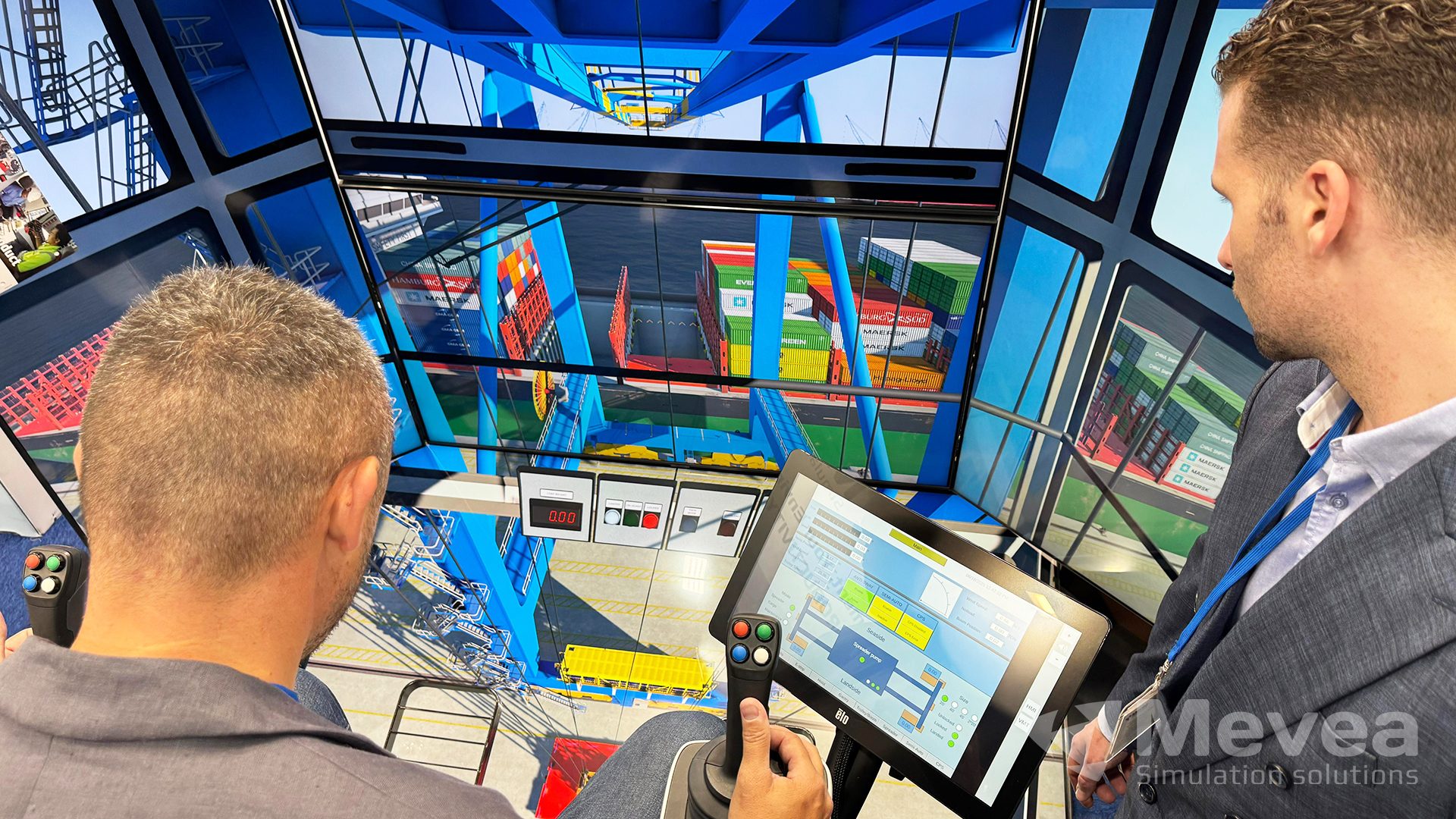
Simulator training measurably improves terminal productivity by accelerating the development of precise operating technique, reducing costly errors, and shortening the time it takes for operators to reach peak performance on real equipment. The gains are most visible in high-throughput operations like ship-to-shore and RTG crane cycles, where small improvements in operator technique compound across thousands of lifts. The questions below unpack exactly how those productivity gains are achieved and sustained — drawing on insights from the on-demand Mevea webinar How Port Operators Are Trained with Simulators, which features a real customer case from Terminal Portuario de Guayaquil (TPG), part of Hanseatic Global Terminals (HGT).
What Specific Productivity Gains Do Terminals See After Simulator Training?
Terminals that invest in simulator-based operator training consistently report measurable improvements in operational throughput. Better-trained operators complete more container moves per hour, make faster and more accurate decisions under pressure, and develop cleaner habits from the start rather than reinforcing poor technique over time. TPG, for example, has directly reported seeing improvements in productivity following the introduction of simulator training, with leadership citing it as one of the most important outcomes for those who approve and fund the investment. This insight comes directly from TPG’s Technical Manager, who shared the terminal’s experience as part of the Mevea webinar replay.
The productivity gains are not the result of one single change. They come from a combination of factors: operators who arrive at real equipment already familiar with controls and procedures, trainers who can use performance data from the simulator to identify and correct weak points, and a more structured training pathway that removes guesswork from skill development. When an operator has already practiced hundreds of container cycles in a controlled environment, their first weeks on live equipment are far more productive than those of an operator trained entirely on the job.
How Does Simulator Training Reduce Costly Operational Errors?
Simulator training reduces costly operational errors by giving operators a safe environment to make mistakes, understand consequences, and build correct habits before they ever touch real equipment. In a port simulator, a collision or a dropped load costs nothing. On a live quay, the same error can damage cargo, equipment, or infrastructure and halt operations for hours.
Beyond accident prevention, the analytical tools built into simulator platforms play a critical role. Our Mevea Instructor Station allows trainers to review operator performance in real time, replay specific manoeuvres, and deliver precise, evidence-based feedback. This kind of structured debriefing is rarely possible during live operations, where a trainer cannot pause the ship or rewind a crane cycle. The result is that errors are identified and corrected systematically rather than left to calcify into long-term bad habits.
Which Terminal Equipment Types Benefit Most From Simulator Training?
Ship-to-shore cranes and rubber-tyred gantry cranes benefit most from simulator training because they are the highest-throughput, highest-consequence equipment in a container terminal. Errors or inefficiencies on STS and RTG equipment have an outsized impact on overall terminal productivity, which makes operator skill in these roles especially valuable.
That said, the benefits extend across a wide range of port equipment. We offer training simulators for STS cranes, RTG cranes, rail-mounted gantry cranes, mobile harbour cranes, reach stackers, empty container handlers, straddle carriers, and terminal tractors. Each equipment type has its own operating demands, and simulator training allows operators to build equipment-specific competence in a structured, repeatable way. For terminals running mixed fleets, the ability to train across multiple equipment types without pulling any of them from production is a significant operational advantage.
How Does Simulator Training Keep Real Equipment Available for Production?
Simulator training keeps real equipment available for production by moving the learning phase entirely off live machinery. Traditional on-equipment training requires pulling a crane, reach stacker, or other asset out of active service for hours or days at a time. Every hour that equipment is used for training is an hour it is not generating throughput.
With a port simulator, trainees build their foundational skills, practice complex scenarios, and work through edge cases entirely in a virtual environment. By the time an operator steps into real equipment, they are already competent rather than beginning from zero. This means the transition from simulator to live machine is shorter, smoother, and far less disruptive to terminal operations. It also means terminals can onboard new operators during peak periods without sacrificing capacity on the quay.
What’s the Difference Between Desktop, Cabin, and Full-Scale Port Simulators?
The key difference between desktop, cabin, and full-scale port simulators is the level of physical immersion they provide, which affects how closely the training experience replicates real operating conditions. Each level suits different training objectives and budget considerations.
- Mevea Desktop is a lightweight, highly portable simulator designed for classroom-based training. It delivers the same physics-based simulation software as higher-tier platforms, making it ideal for introducing controls, procedures, and decision-making without requiring a dedicated training facility.
- Mevea Pro is a professional-grade simulator platform featuring a 3 DOF motion platform and between three and ten screens. It provides a realistic, immersive experience that closely replicates the physical sensations of operating heavy equipment, making it well suited for skills development and competency assessment.
- Mevea Master King is a full-scale cab simulator built for maximum immersion. It replicates the exact look, feel, and layout of a real operator cab, making it the most effective tool for advanced training and final-stage preparation before live equipment operation.
All three levels run on the same physics engine and include the Mevea Instructor Station, so the quality of the underlying simulation and the depth of performance feedback remain consistent regardless of which platform a terminal chooses.
How Long Does It Take to See Productivity Improvements After Simulator Training?
Productivity improvements from simulator training typically become visible from the first days an operator works on real equipment. Because operators arrive with established procedural knowledge and practiced motor habits, they reach a functional level of competence faster than operators trained entirely on live machinery. The improvement is not a gradual drift upward over months but a higher starting point from day one.
The speed and scale of the gains depend on several factors: the quality and duration of the simulator programme, how well the training scenarios reflect actual terminal conditions, and how effectively instructors use performance data to guide development. Terminals that use structured training programmes with regular debriefing and scenario repetition tend to see stronger and more consistent results than those that treat simulator time as unstructured practice. Over time, as more of the operator workforce passes through simulator-based training, the cumulative effect on terminal-wide productivity becomes increasingly significant.
Watch the Webinar: How Port Operators Are Trained with Simulators
The insights and customer case discussed throughout this article are drawn from the on-demand Mevea webinar replay How Port Operators Are Trained with Simulators. The webinar features a real-world case from Terminal Portuario de Guayaquil (TPG), part of Hanseatic Global Terminals (HGT), including first-hand perspectives from TPG’s Technical Manager on how simulator-based training has improved operator performance, reduced costs, and minimised operational disruption.
Improving operator training while reducing costs and avoiding operational disruptions is a key challenge for modern container terminals. Simulator-based training provides a scalable and cost-efficient solution that improves safety, productivity, and workforce readiness in demanding port operations — and this webinar shows exactly how one leading terminal has put it into practice.
Watch the on-demand webinar replay now to see how HGT and TPG are transforming port operator training with Mevea simulators.
This content was generated with the help of AI and it may contain mistakes