Ports can use simulation to introduce new talent to crane operations by giving potential recruits hands-on experience with crane controls and terminal environments before they ever touch real equipment. Simulation removes the pressure and risk of learning on live machinery, making the profession accessible to people who have no prior port experience. The questions below unpack how this works in practice, from the basics of simulator training to how ports measure its results. The insights in this article are drawn from the Mevea webinar How Port Operators Are Trained with Simulators, which features a real customer case from Hanseatic Global Terminals (HGT) and their terminal Terminal Portuario de Guayaquil (TPG). Watch the on-demand webinar replay here.
What Makes Crane Operations Difficult for New Port Workers to Learn?
Crane operations are difficult to learn because they combine precise spatial awareness, complex multi-axis controls, and high-stakes decision-making in a fast-moving environment. New workers must simultaneously manage load dynamics, coordinate with ground crews, and follow strict safety protocols, all from a cab that can sit dozens of meters above the terminal floor. The consequences of errors are immediate and serious, which creates significant pressure on anyone learning from scratch.
For someone who has never worked in a port, the challenge is compounded by unfamiliarity with the environment itself. Terminal layouts, communication procedures, and equipment terminology are all new. Trainees are not just learning how to operate a machine, they are learning an entire occupational culture at the same time. This steep learning curve has historically made it difficult for ports to attract and retain new talent, particularly from outside the industry.
The physical demands of the role add another layer. Operators must develop fine motor control to handle loads smoothly, and that muscle memory takes time to build. On real equipment, every mistake carries a cost, in safety risk, in equipment wear, and in lost productivity. This is precisely why the entry barrier into crane operations has traditionally been high.
How Does Simulation Training Work for Port Crane Operators?
Crane simulation training works by replicating the controls, physics, and operating environment of real port equipment inside a virtual setting. A trainee sits at a simulator station that mirrors the layout of an actual crane cab, uses the same types of controls, and receives realistic feedback on how the load responds to their inputs. Physics-based simulation engines model the behavior of the crane and its load accurately, so the skills developed in the simulator transfer directly to real equipment.
Training scenarios can be structured progressively. A new operator might begin with basic load handling in calm conditions, then advance to working in wind, rain, or reduced visibility. Instructors manage scenarios from a dedicated station, adjusting conditions in real time and reviewing performance data after each session. This gives trainers precise control over the learning experience and allows them to tailor difficulty to each individual’s development.
Simulation also opens a less formal use that ports are beginning to explore. Some terminal operators invite people who have never worked in a port at all to try a simulator session as an introduction to the profession. The goal is not to complete a training program but to give potential recruits a realistic, engaging first look at what crane operation involves: the controls, the environment, the nature of the work. This kind of exposure can spark genuine interest in a career path that might otherwise seem inaccessible or unknown. The Mevea webinar How Port Operators Are Trained with Simulators explores exactly this approach, including how TPG, part of Hanseatic Global Terminals (HGT), has put it into practice. Watch the on-demand replay to hear directly from TPG’s Technical Manager.
What Are the Benefits of Using Simulators to Onboard New Crane Operators?
Using simulators to onboard new crane operators reduces risk, lowers training costs, and accelerates the time it takes for a new hire to reach productive performance on real equipment. Trainees can make mistakes and learn from them without endangering colleagues, damaging cargo, or disrupting terminal operations. The simulator is always available, requires no fuel, and keeps real cranes free for revenue-generating work.
Beyond the operational advantages, simulation changes the nature of the onboarding experience itself. New operators arrive at real equipment having already built foundational skills and familiarity with the working environment. That confidence matters. Operators who have trained on a simulator tend to perform more consistently from their first sessions on live machinery, which benefits both the individual and the port.
There is also a workforce development dimension that goes beyond formal training. Simulation can serve as an accessible introduction for people considering a career in port operations, including those who have never operated any kind of crane or worked in a terminal. Giving prospective recruits a low-stakes opportunity to experience the profession firsthand is a practical tool for employer branding and talent pipeline development, not just a training method for existing hires. Improving operator training while reducing costs and avoiding operational disruptions is a key challenge for modern container terminals — and simulator-based training, as demonstrated in the Mevea webinar featuring HGT and TPG, provides a scalable and cost-efficient solution that improves safety, productivity, and workforce readiness.
What Types of Crane Simulators Are Available for Port Training Programs?
Port training programs can choose from a range of crane simulator types, covering different equipment categories and different levels of hardware immersion. The right choice depends on the port’s equipment mix, training volume, and available space and budget.
Equipment-specific simulators
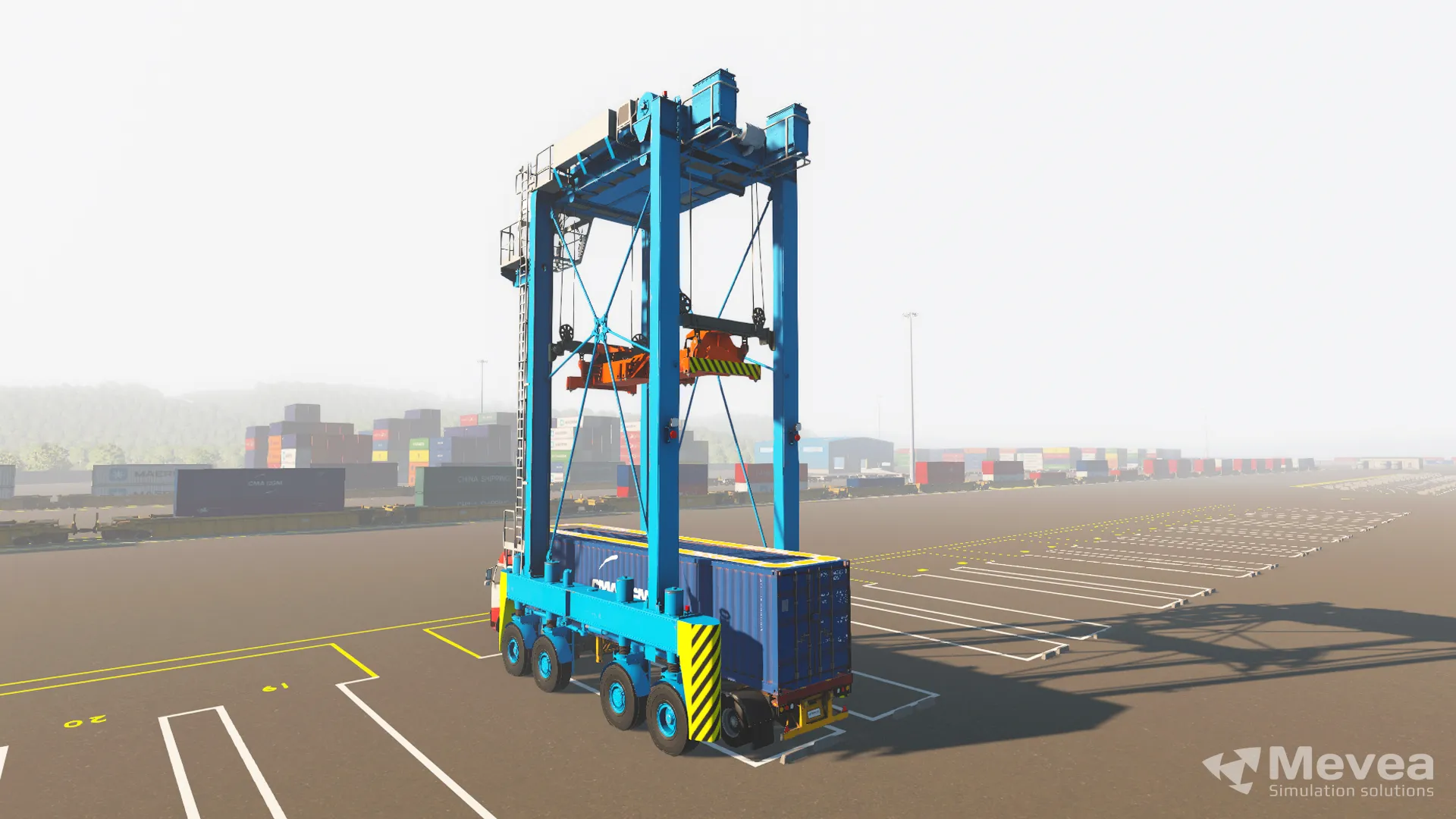
Simulators are available for the full range of port crane types, including Ship-to-Shore (STS) cranes, Rubber Tyred Gantry (RTG) cranes, Rail Mounted Gantry (RMG) cranes, Mobile Harbour Cranes, reach stackers, straddle carriers, and terminal tractors. Each simulator replicates the specific controls and operating characteristics of that machine, so training is directly applicable to the equipment a new operator will use on the job. We offer port equipment simulators covering this full range, built on physics-based simulation that accurately models crane mechanics, hydraulics, and load behavior.
Hardware platform options
Simulator hardware comes in several configurations to match different training contexts. Desktop simulators are compact and portable, making them practical for classroom-based introduction sessions, including the kind of career awareness events where potential recruits try crane operation for the first time. Mid-range platforms add multiple screens and motion systems to deliver a more immersive experience. Full-scale cab simulators replicate the operator environment at 1:1 scale for maximum realism and are well suited to advanced training and competency assessment. Ports can combine hardware tiers across their program, using desktop units for early-stage exposure and full-scale simulators for final qualification.
When Should a Port Introduce Simulation into Its Training Program?
A port should introduce simulation as early as possible in the training pathway, ideally before a new recruit ever enters a live crane cab. Starting with simulation means trainees arrive at real equipment with baseline skills already in place, which shortens the time they need supervised access to operational machinery and reduces the risk of costly early mistakes.
For ports thinking about talent pipelines, simulation can be introduced even earlier: before formal recruitment begins. Inviting people who have never worked in a port to experience a simulator session is a practical way to lower the entry barrier to an unfamiliar profession. If the goal is simply to spark interest and give potential future operators a realistic sense of the work, a brief desktop simulation session is enough. No formal training plan is required, just a good scenario and an experienced guide.
For existing workforce development, simulation fits naturally at multiple points: initial onboarding, equipment transitions when an operator moves from one crane type to another, refresher training after an extended absence, and competency checks before assigning operators to more demanding tasks. Ports that treat simulation as a continuous tool rather than a one-time onboarding step get the most sustained benefit from their investment.
How Do Ports Measure the Effectiveness of Crane Simulator Training?
Ports measure the effectiveness of crane simulator training by tracking performance data generated during simulator sessions and comparing it against outcomes on real equipment. Modern simulators record detailed metrics for every session: load handling precision, cycle times, control inputs, error rates, and response to changing conditions. This data gives instructors an objective picture of each trainee’s progress that is difficult to gather on live equipment without disrupting operations.
On-the-job performance provides the ultimate validation. Ports that have implemented structured simulation programs typically track how quickly new operators reach acceptable productivity levels on real cranes, how their error rates compare to operators trained by traditional methods, and how their safety record develops over time. When simulator-trained operators consistently reach competency faster and with fewer incidents, the training program demonstrates its value in measurable operational terms.
Instructor feedback is a complementary layer. The instructor station built into professional simulator platforms allows trainers to observe every session in real time, annotate specific moments for debrief, and generate session reports. This structured feedback loop accelerates learning and gives training managers the documentation they need to demonstrate program quality to port leadership and external auditors. Together, data-driven session metrics and real-world performance outcomes give ports a clear, evidence-based picture of what their crane simulation training is achieving.
To see these principles in action through a real-world example, watch the on-demand replay of the Mevea webinar How Port Operators Are Trained with Simulators. The webinar features firsthand insights from the Technical Manager at Terminal Portuario de Guayaquil (TPG), part of Hanseatic Global Terminals (HGT), on how simulator-based training has improved safety, productivity, and workforce readiness at their container terminal. Watch the webinar replay now.
This content was generated with the help of AI and it may contain mistakes