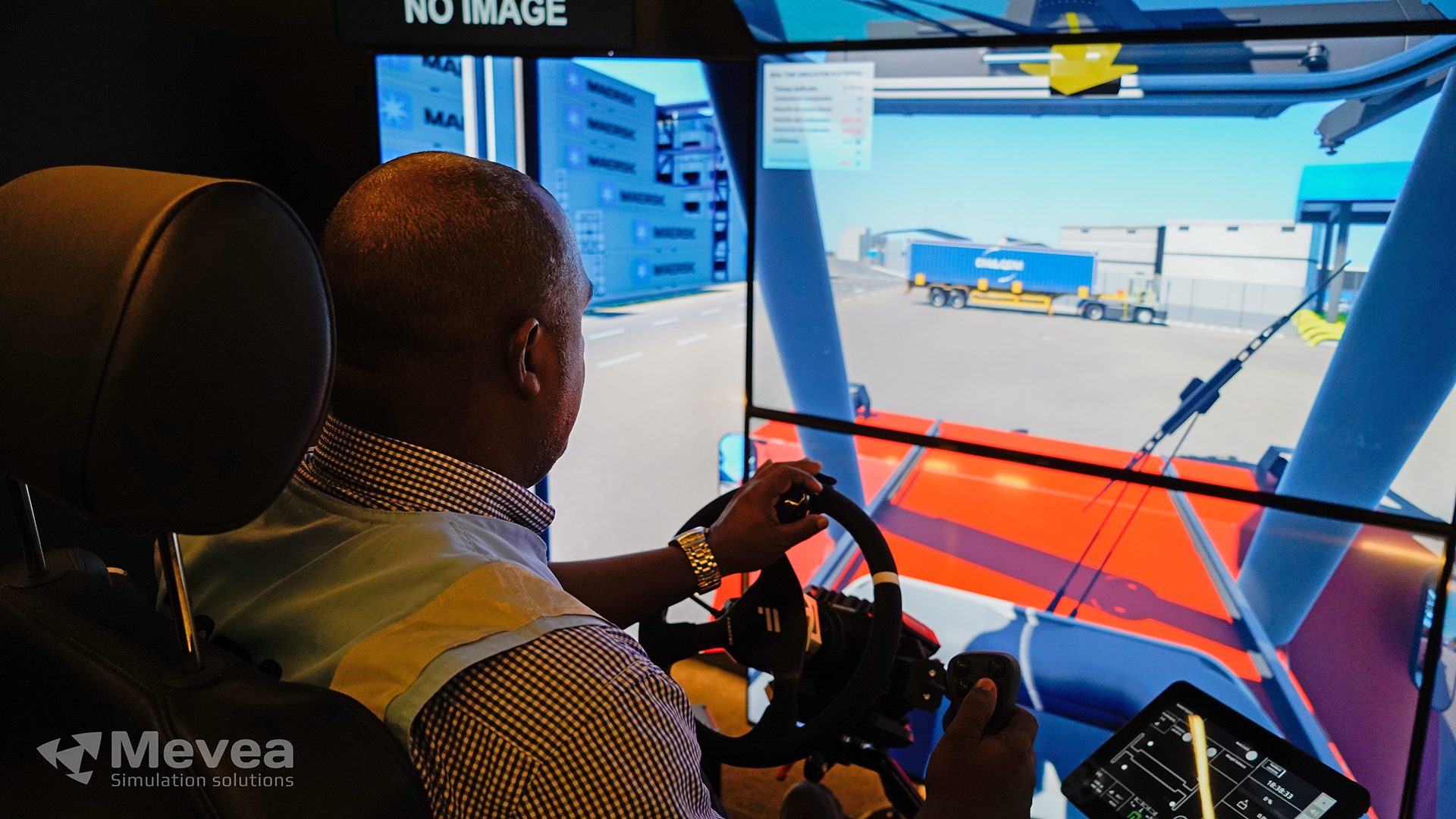
The insights in this article are drawn from the on-demand Mevea webinar replay, How Port Operators Are Trained with Simulators, featuring a real customer case from Terminal Portuario de Guayaquil (TPG), part of Hanseatic Global Terminals (HGT). The replay includes perspectives from the Technical Manager at TPG on how simulator-based training improves safety, productivity, and workforce readiness while reducing costs and operational disruptions. Watch the on-demand webinar replay here.
Customized training simulators deliver better results for individual port terminals, while generic simulators serve training institutions and multi-equipment environments more effectively. The right choice depends on whether your priority is broad operational versatility or precise skill transfer tied to your terminal’s specific equipment and workflows. The questions below break down exactly how to think through that decision.
What Are the Key Differences Between Generic and Customized Port Training Simulators?
Generic port training simulators are designed to cover a wide range of equipment types and operational scenarios without being tied to any specific terminal’s setup. Customized simulators, by contrast, are built or configured to replicate your terminal’s actual equipment, console layouts, yard configurations, and operational processes, making training directly transferable to the job from day one.
In practice, a generic simulator gives trainees a solid foundation in crane operation, load handling, and spatial awareness. It is versatile by design. A customized simulator goes further: it can replicate the exact console interface your operators use, mirror your terminal’s specific loading sequences, and simulate the environmental conditions your team faces regularly. The result is that operators trained on a customized system spend far less time adapting when they step into the real machine.
Think of it this way: a generic simulator teaches someone to drive; a customized simulator teaches them to drive your vehicle, on your routes, following your procedures.
What Types of Port Equipment Can Be Replicated in a Customized Simulator?
A customized port simulator can replicate virtually any piece of terminal equipment, including Ship-to-Shore (STS) cranes, Rubber Tyred Gantry (RTG) cranes, Rail Mounted Gantry (RMG) cranes, Mobile Harbour Cranes (MHC), reach stackers, straddle carriers, empty container handlers, terminal tractors, and offshore cranes.
Beyond the equipment type itself, customization extends to the operator console. We can replicate your crane consoles precisely: button layouts, display configurations, joystick behavior, so that muscle memory built in the simulator transfers directly to the real machine. For terminals operating multiple crane variants, several console layouts can be configured within the same simulator platform, meaning a single training system can serve different crane types across your fleet.
Realistic training scenarios can also be layered in: varying weather conditions, shift-specific cargo flows, and the exact yard layout your operators navigate daily. This level of specificity is what separates a port equipment simulator built for your terminal from an off-the-shelf solution.
How Does Simulator Customization Affect Operator Training Outcomes?
Customization significantly improves training outcomes by increasing the relevance and direct applicability of every exercise. When simulator exercises match your terminal’s actual processes, operators build skills that transfer immediately to real equipment, reducing the gap between training performance and on-the-job performance.
As demonstrated in the TPG customer case featured in the Mevea webinar, terminals can develop exercises that fit their specific processes and ways of working. That means trainees are not learning abstract crane operation: they are learning your crane operation. This specificity accelerates competency development, reduces errors during the early stages of live operation, and builds operator confidence faster.
Generic simulators still improve baseline skills, but they require an additional adaptation period when operators move to real equipment. In high-throughput port environments where productivity is measured in moves per hour, that adaptation gap has a real operational cost.
When Does a Generic Simulator Make Sense for Port Training?
A generic operator training simulator makes the most sense for training institutions, academies, and organizations that need to prepare operators for a variety of equipment types rather than one specific terminal setup. It also suits ports that are onboarding new operators who need foundational skills before being assigned to specific machinery.
For training providers serving multiple clients across different terminals, generic versatility is genuinely valuable. A single simulator that covers STS cranes, RTGs, reach stackers, and harbour cranes allows instructors to deliver broad curricula without investing in multiple customized platforms.
Generic simulators are also a practical starting point when a terminal is evaluating simulation technology before committing to a fully customized solution. They provide a lower entry cost and faster deployment, making them a reasonable choice when the primary goal is exposure and basic skill development rather than terminal-specific performance optimization.
What Are the Long-Term Cost Differences Between Generic and Customized Simulators?
Customized simulators typically carry a higher upfront investment than generic alternatives, but they tend to deliver stronger long-term cost efficiency for terminals with stable, defined equipment fleets. The key driver is training effectiveness: operators who train on equipment that matches what they will actually use require less remedial training, make fewer costly errors, and reach full productivity faster.
It is also worth noting that not every crane in a large fleet necessarily needs to be individually replicated. A practical approach is to identify the equipment configurations that provide the greatest training value, typically the most complex or highest-risk machinery, and customize around those. This balances the depth of customization against project cost without sacrificing the core benefit.
Generic simulators reduce initial spend but may require supplemental on-equipment training time, which reintroduces the costs of fuel consumption, equipment wear, and reduced availability for productive operations. Over a multi-year training program, the total cost difference between the two approaches often narrows considerably in favor of customization.
Which Simulator Type Delivers Better Safety Outcomes in Port Operations?
Customized simulators deliver stronger safety outcomes for established port terminals because they allow operators to rehearse the specific high-risk scenarios they will actually encounter, in the exact equipment environment they will work in. When training mirrors reality closely, operators are better prepared to respond correctly under pressure.
Both simulator types eliminate the most fundamental safety risk: putting an inexperienced operator on live equipment in a busy terminal. In that sense, any simulator for ports improves safety compared to traditional on-the-job training. But the quality of that preparation differs meaningfully.
A customized harbour crane simulator can replicate the precise load dynamics, visibility conditions, and control responses your operators will face. Instructors can introduce emergency scenarios, equipment malfunctions, and adverse weather within the simulator environment, building response capability without any real-world risk. The closer the simulation is to the actual operating environment, the more durable and reliable those safety behaviors become when it counts.
To see how these principles work in practice, watch the on-demand replay of the Mevea webinar How Port Operators Are Trained with Simulators, which features a real-world customer case from Terminal Portuario de Guayaquil (TPG), part of Hanseatic Global Terminals (HGT), and includes direct insights from TPG’s Technical Manager. Watch the webinar replay now.
This content was generated with the help of AI and it may contain mistakes