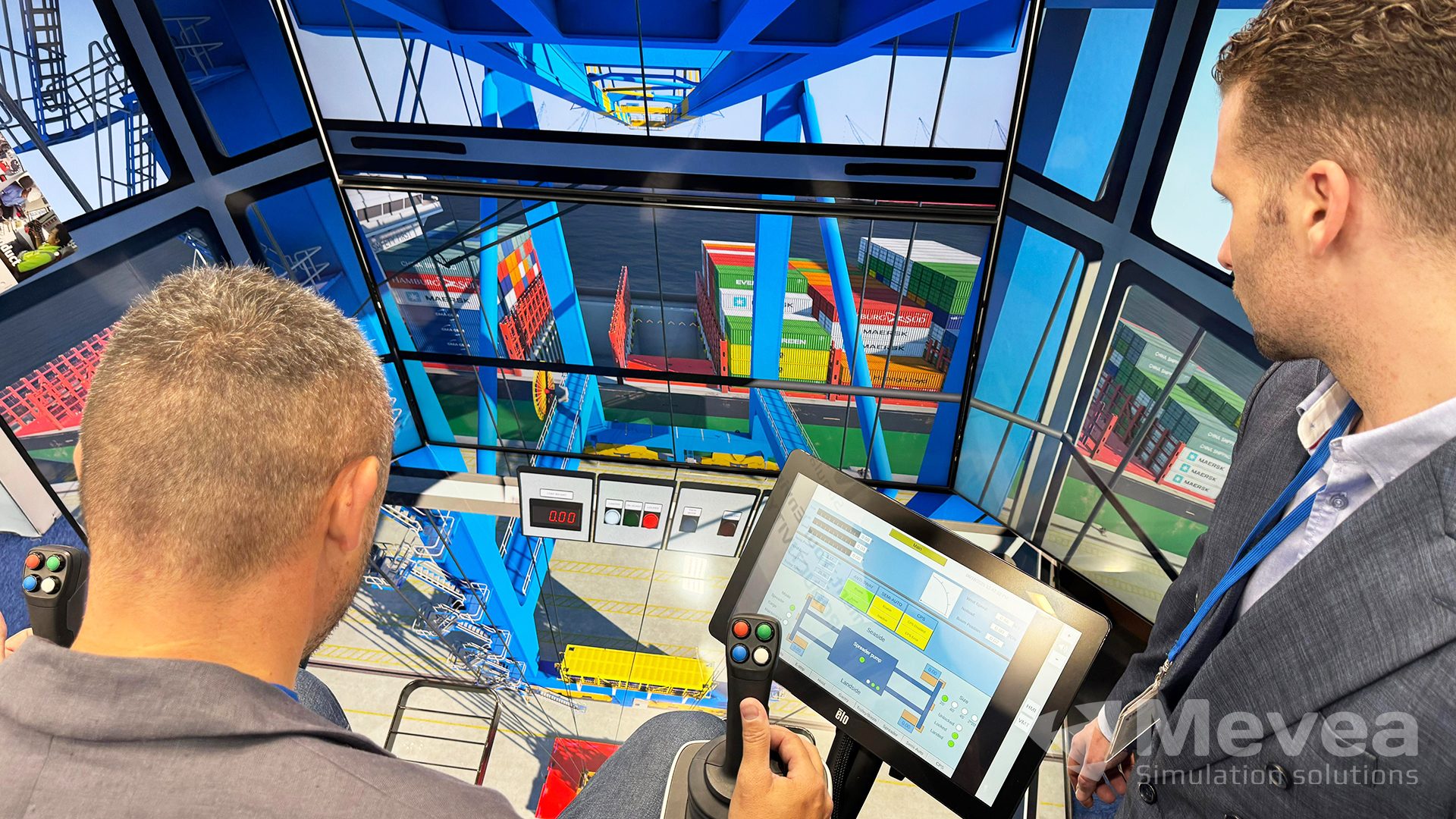
Yes, training simulators can genuinely help ports attract the next generation of operators. By giving potential recruits a hands-on, low-risk way to experience crane and terminal work before committing to a career, simulators lower the barrier to entry and make port operations feel accessible rather than intimidating. The sections below explore exactly how that works, what equipment candidates can train on, and why simulation is increasingly central to port workforce development. The insights in this article are drawn from the on-demand Mevea webinar How Port Operators Are Trained with Simulators, which features a real customer case from Terminal Portuario de Guayaquil (TPG), part of Hanseatic Global Terminals (HGT).
Why Are Ports Struggling to Recruit Young Operators?
Ports are struggling to recruit young operators primarily because the work is largely invisible to people outside the industry. Unlike careers in technology, logistics software, or even construction, operating a ship-to-shore crane or a rubber-tyred gantry crane is not something most young people have ever seen up close, let alone tried. Without exposure, it is difficult to generate genuine interest or career ambition.
The skills gap compounds the visibility problem. Port equipment operation requires precision, spatial awareness, and the ability to perform under pressure in complex environments. New recruits cannot simply shadow an experienced operator in the cab of a 50-metre-high STS crane without creating serious safety risks. That practical barrier has historically made it hard to run meaningful taster programmes or open days that show young people what the job actually involves.
At the same time, the industry is facing a generational transition. Experienced operators are retiring, and the pipeline of trained replacements is not keeping pace. Port workforce development has become a strategic priority for terminal operators worldwide, and the recruitment challenge is inseparable from the training challenge.
How Do Training Simulators Make Port Careers More Appealing to Younger Workers?
Training simulators make port careers more appealing to younger workers by letting them experience the job safely and immediately, without any prerequisites. A person who has never operated a crane in their life can sit down at a simulator, take control of a harbour crane or reach stacker, and get a realistic sense of what the work feels like within minutes. That direct experience is far more compelling than a brochure or a job description.
This is the distinction between a recruitment tool and an attraction tool. Simulators do not replace the hiring process, but they create genuine interest in future operator careers among people who would otherwise never consider port work. Terminals that have introduced community outreach programmes, inviting people from surrounding neighbourhoods to try simulator sessions, report that participants leave motivated and curious in a way that no amount of employer marketing could achieve alone.
For younger workers specifically, the technology itself carries appeal. High-fidelity simulators with realistic physics, multiple screens, and motion platforms feel closer to advanced gaming environments than to traditional industrial training. That familiarity lowers psychological resistance and positions port operation as a modern, skill-based profession rather than a dated manual trade.
What Types of Port Equipment Can Operators Train on with Simulators?
Operators can train on a wide range of port equipment using simulators, covering virtually every major machine type found in a modern container terminal or bulk cargo port. The breadth of available simulation means that a trainee can build competence across multiple equipment types before ever stepping onto a live terminal.
The equipment categories typically covered include:
- Ship-to-Shore (STS) cranes for loading and unloading container vessels
- Rubber-Tyred Gantry (RTG) cranes for yard stacking operations
- Rail Mounted Gantry (RMG) cranes for automated or semi-automated yard environments
- Mobile Harbour Cranes (MHC) for flexible multi-purpose cargo handling
- Reach stackers for container stacking and intermodal transfers
- Empty container handlers and straddle carriers
- Terminal tractors and Internal Transfer Vehicles (ITV) for horizontal transport
- Offshore cranes for marine and energy sector applications
Our port equipment training simulators cover all of these categories, with realistic training scenarios that replicate loading and unloading operations across varying weather and environmental conditions. Trainees can practise the same task repeatedly, in different scenarios, without any cost to equipment or cargo.
How Does Simulator Training Compare to On-the-Job Training for New Recruits?
Simulator training gives new recruits a structured, repeatable, and risk-free learning environment that on-the-job training cannot match in the early stages of development. On-the-job training is valuable, but it exposes inexperienced operators to real equipment, real cargo, and real colleagues from the first session, creating pressure that can slow learning and increase the likelihood of costly errors.
With simulator training, a new recruit can make mistakes, repeat difficult manoeuvres, and build muscle memory without any consequences beyond the lesson itself. Instructors can pause scenarios, replay sequences, and adjust conditions in real time using an instructor station, giving feedback that would be impossible to deliver safely during live operations.
On-the-job training remains essential, but it works best once a trainee has already developed foundational competence through simulation. The two approaches are complementary rather than competing. Recruits who arrive at their first live shift having already logged hours on a simulator are measurably more confident and require less supervision, which also reduces the burden on experienced operators who would otherwise spend time mentoring beginners on live equipment.
Can Simulator Training Actually Produce Competent Port Operators?
Yes, simulator training can produce genuinely competent port operators, provided the simulation is physically accurate enough to transfer real skills. The critical factor is the fidelity of the physics engine underlying the simulator. If the crane behaves differently in simulation than it does in reality, the training value is limited. When the simulation accurately replicates machine mechanics, hydraulics, load dynamics, and environmental conditions, the skills operators develop transfer directly to live equipment.
Our simulation technology is built on the most advanced physics-based digital twin engine available on the market, designed specifically to replicate the real-world behaviour of heavy machinery in real time. This means trainees are not learning a simplified approximation of crane operation. They are learning the actual inputs, timing, and judgements that the job demands.
Industry experience consistently shows that operators trained on high-fidelity simulators reach productive performance levels faster than those trained exclusively on the job. They also tend to operate more safely in the early months of live work, because they have already encountered and resolved challenging scenarios in a controlled environment before facing them on a real terminal. The customer case from TPG, featured in the Mevea webinar replay, offers direct evidence of how simulator-based training improves safety, productivity, and workforce readiness in a real container terminal environment.
What Role Do Simulators Play in Preparing Operators for Remote and Autonomous Port Equipment?
Simulators play a central role in preparing operators for remote-controlled and autonomous port equipment, because these technologies require a fundamentally different set of skills that cannot be developed through traditional hands-on training. Remote operation removes the operator from the cab entirely, replacing direct physical feedback with camera feeds, sensor data, and control interfaces that must be interpreted and acted upon from a distance.
Training for remote operation on live equipment is impractical and expensive. Simulators provide the only realistic way to build the perceptual skills and decision-making habits that remote port operations demand, in a safe and repeatable environment. Operators can practise interpreting camera angles, responding to latency, and managing the reduced situational awareness that comes with not being physically present on the machine.
We offer dedicated simulator configurations for remote-operated port equipment, recognising that autonomous and semi-autonomous terminals are no longer a distant prospect but an active reality for many of the world’s leading port operators. As automation expands across the industry, the operators who will be most valuable are those who can work alongside autonomous systems, intervene when needed, and manage exceptions that automated processes cannot handle alone. Simulator training is the most effective way to develop that hybrid skill set before the technology is fully deployed.
To see how simulator-based operator training works in practice — including insights from the Technical Manager at TPG on improving training outcomes while reducing costs and avoiding operational disruptions — watch the on-demand replay of the Mevea webinar How Port Operators Are Trained with Simulators.
This content was generated with the help of AI and it may contain mistakes