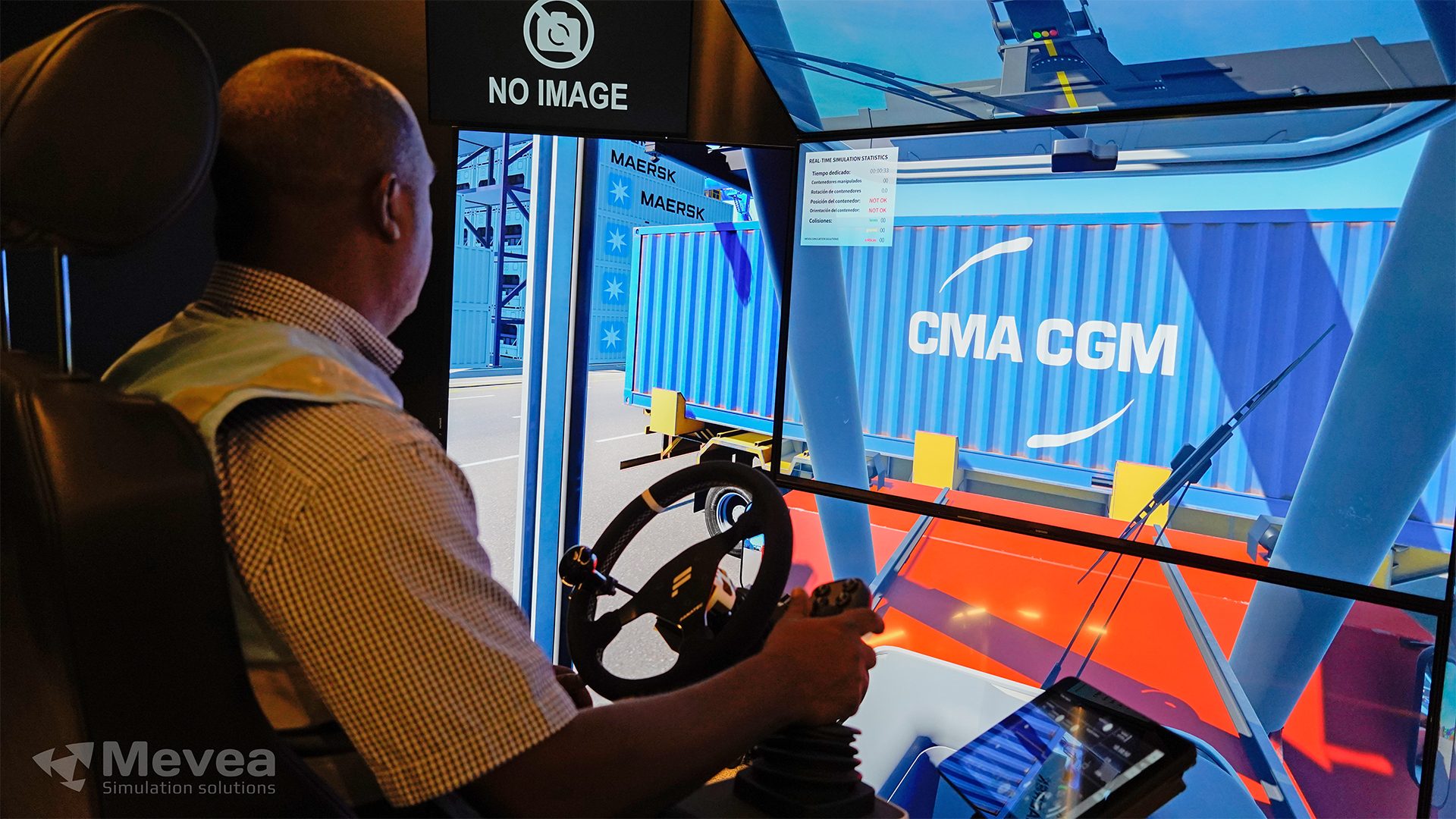
Yes, better operator training can meaningfully extend the life of port equipment. Skilled operators place less mechanical stress on machinery through smoother acceleration, more controlled load handling, and fewer abrupt movements that accelerate wear on critical components. The connection between operator behaviour and equipment health is direct and well-documented in port operations. The questions below unpack exactly how that relationship works and what training approaches make the biggest difference. The insights in this article are drawn from the on-demand Mevea webinar How Port Operators Are Trained with Simulators, which features a real customer case from Terminal Portuario de Guayaquil (TPG), part of Hanseatic Global Terminals (HGT). Watch the webinar replay here.
How Does Poor Operator Technique Damage Port Equipment?
Poor operator technique damages port equipment by introducing unnecessary mechanical stress during routine operations. Abrupt acceleration and deceleration, jerky spreader movements, and improper load handling all place forces on structural components, hydraulic systems, and drive mechanisms that exceed what smooth, controlled operation would generate. Over time, this cumulative stress accelerates wear and shortens equipment service intervals.
In practice, the most damaging habits tend to cluster around transitions: starting and stopping movements too quickly, swinging loads rather than positioning them with precision, and overriding system limits in ways the equipment was not designed to absorb repeatedly. A crane operator who consistently decelerates too late, for example, generates shock loads through the hoist mechanism that a well-timed approach would avoid entirely. These are not dramatic failures but gradual degradations that show up in maintenance logs months later.
The challenge is that many of these behaviours are invisible to operators in the moment. Without feedback, a new operator has no way of knowing that a movement felt acceptable but was mechanically costly. This is precisely where structured training makes a measurable difference.
What Types of Equipment Damage Can Training Help Prevent?
Operator training can help prevent several categories of equipment damage, particularly those caused by controllable behaviour rather than age or manufacturing defects. The most preventable damage types include accelerated wear on hydraulic components, mechanical fatigue in structural joints and wire ropes, excessive brake wear, and damage to spreader mechanisms from imprecise container engagement.
- Hydraulic system wear: Aggressive joystick inputs cause pressure spikes that stress seals, valves, and cylinders beyond their intended operating range.
- Wire rope and sheave fatigue: Rapid load cycling and shock loading shorten the service life of hoist systems significantly faster than smooth operation.
- Brake and drive system wear: Frequent hard stops place disproportionate load on braking components across RTG, RMG, and STS cranes.
- Spreader and twistlock damage: Misaligned container engagement, a common error among inexperienced operators, causes repeated impact stress on spreader arms and locking mechanisms.
- Structural stress: Swinging loads and off-centre lifts introduce lateral forces that structural components are designed to minimise, not absorb routinely.
Training does not eliminate all equipment damage, but it removes the avoidable portion caused by technique rather than operational necessity.
How Does Simulator Training Reduce Wear on Real Port Equipment?
Simulator training reduces wear on real port equipment by ensuring operators develop correct technique before they ever touch live machinery. When trainees practise on a simulator, all the learning-curve mistakes, including rough inputs, misjudged distances, and hesitant corrections, happen in a virtual environment with no mechanical consequence. By the time an operator steps into a real cab, their movements are already calibrated.
This is one of the key themes explored in the Mevea webinar How Port Operators Are Trained with Simulators, which features insights from the Technical Manager at Terminal Portuario de Guayaquil (TPG), part of Hanseatic Global Terminals (HGT). Observations from port operations where simulator training has been introduced consistently point to the same outcome: operators who have trained on simulators demonstrate a stronger understanding of the importance of handling equipment carefully. They apply appropriate acceleration and deceleration, manage spreader movements with greater precision, and are more aware of how their inputs translate into mechanical load. As one port operator noted after implementing simulator training, operators better understood the need to handle equipment with care, and many of the improvements observed were directly related to the health of the equipment.
This matters because the physics of how a crane or reach stacker responds to operator input is something that can be learned and internalised before real equipment is involved. Our physics-based simulation software replicates the mechanical behaviour of port equipment with high fidelity, which means the movement habits operators develop in training transfer directly to real-world operation.
Do Better-Trained Staff Actually Lower Maintenance Costs?
Better-trained staff can lower maintenance costs, though the relationship is indirect rather than guaranteed. When operators handle equipment with greater care, the components subject to technique-driven wear, such as brakes, hydraulics, wire ropes, and structural joints, experience less cumulative stress. This can extend service intervals, reduce the frequency of unplanned repairs, and lower the overall cost of keeping equipment operational.
The most direct cost reductions come from fewer incidents of damage caused by operator error, which in port environments can range from minor spreader contact to more significant structural impacts. Beyond repair costs, better-trained operators also reduce downtime, keeping equipment available for productive use rather than out of service for maintenance. When real equipment stays in operation longer between service events, the return on training investment compounds over time.
It is important to be precise here: training improves technique, and better technique reduces avoidable wear. The degree of maintenance cost reduction depends on the baseline skill level of the workforce, the intensity of operations, and the types of equipment involved. The connection is real and logical, but it plays out over months and years rather than immediately.
What’s the Difference Between Desktop, Cab, and Full-Scale Port Simulators?
The key difference between desktop, cab, and full-scale port simulators is the level of physical immersion they provide, which affects how closely the training experience mirrors real equipment operation. Each level serves a different training purpose and budget profile.
Desktop Simulators
Desktop simulators, such as our Mevea Desktop platform, are compact, portable units suited to classroom-based instruction and initial skills development. They deliver accurate physics-based simulation in a lightweight format that can be transported easily between training locations. They are ideal for introducing operators to equipment controls, building foundational awareness, and conducting theory-linked practical exercises without requiring a dedicated simulator facility.
Professional Cab Simulators
Mid-tier platforms like our Mevea Pro offer a more immersive experience, typically combining a multi-screen visual environment with a motion platform that physically responds to simulated equipment movement. With three degrees of freedom and up to ten display screens, this level replicates the sensory feedback of operating real equipment far more closely than a desktop unit. It is well-suited to competency development and proficiency assessment for experienced operators.
Full-Scale Cab Simulators
Full-scale simulators replicate the actual operator cab of a specific machine, providing maximum immersion for high-stakes training scenarios. These are used where the training objective demands the closest possible match to the real operating environment, including spatial layout, control ergonomics, and visual field. For ports training operators on STS cranes or other complex equipment, this level of fidelity supports both initial certification and advanced skill development.
When Should a Port Operator Invest in Simulation-Based Training?
A port operator should consider investing in simulation-based training when the cost of training on real equipment, whether measured in downtime, fuel, wear, or safety risk, begins to outweigh the cost of a dedicated training solution. This threshold arrives sooner than many operators expect, particularly at ports with high operator turnover, expanding fleets, or equipment that cannot be easily taken offline for training purposes.
The clearest signals that simulation-based training makes sense include:
- High onboarding frequency: When new operators need to be trained regularly, using live equipment for every training cycle creates cumulative wear and operational disruption.
- Complex or high-value equipment: STS cranes, RTG cranes, and similar assets represent significant capital investment. Training errors on this equipment carry real financial consequences.
- Safety-critical environments: Ports where live training creates meaningful risk to personnel or cargo benefit immediately from a consequence-free training environment.
- Productivity targets: Operators trained on simulators tend to reach operational competency faster, which directly supports throughput goals.
- Sustainability commitments: Simulator training eliminates the fuel consumption and emissions associated with running real equipment for training purposes.
The operator training ROI case for simulation is strongest when all these factors are considered together rather than in isolation. Ports that have made the investment consistently report that the combination of reduced equipment wear, lower incident rates, and faster operator development justifies the cost well within the first few years of operation.
To see how this works in practice, watch the on-demand replay of the Mevea webinar How Port Operators Are Trained with Simulators, featuring a real customer case from Terminal Portuario de Guayaquil (TPG), part of Hanseatic Global Terminals (HGT), and hear directly from the Technical Manager at TPG about the results their team achieved. Watch the webinar replay now.
This content was generated with the help of AI and it may contain mistakes